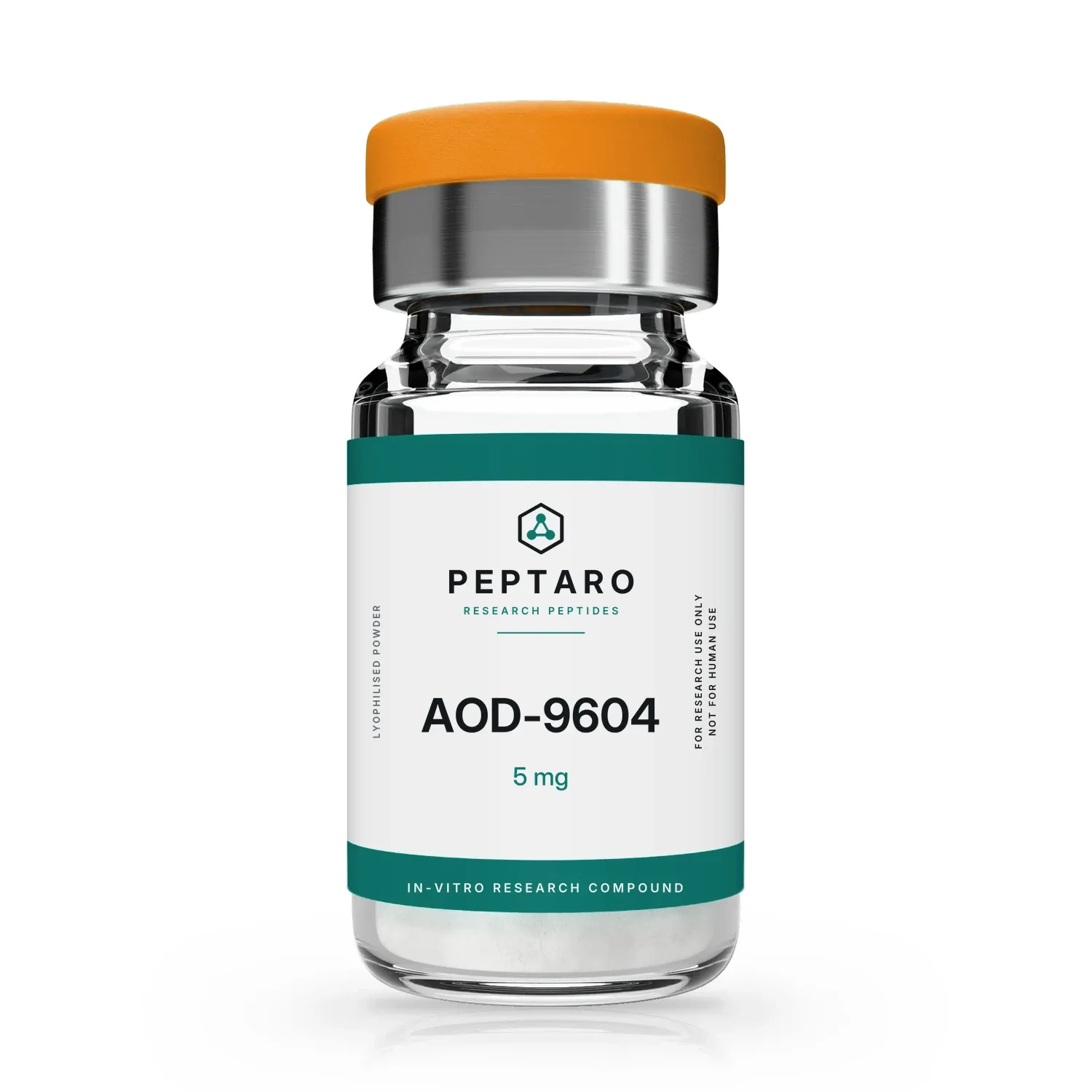
AOD-9604
5mg
In Stock · Ready to Ship£34.99£7.00/mg
98.8% RP-HPLCJanoshikBatch UKPL-782
£9.95£1.99/mg
Out of stock
Minimum order £299.00 per basket: mix any products. Research kits meet it on their own.
Dispatched same day if ordered by 3pm (Mon–Fri) · Royal Mail Tracked 24
| Vials in basket | Per vial | Saving |
|---|---|---|
| 1–2 | £9.95 | — |
| 3+ | £9.45 | 5% |
| 5+ | £9.15 | 8% |
| 10+ | £8.76 | 12% |
Discounts are basket-wide: mix any vials.
Documentation for each item ships with your order.
For in-vitro laboratory research use only. Not for human or veterinary use.
Documentation for each item ships with your order. The batch number printed on your vial matches it.
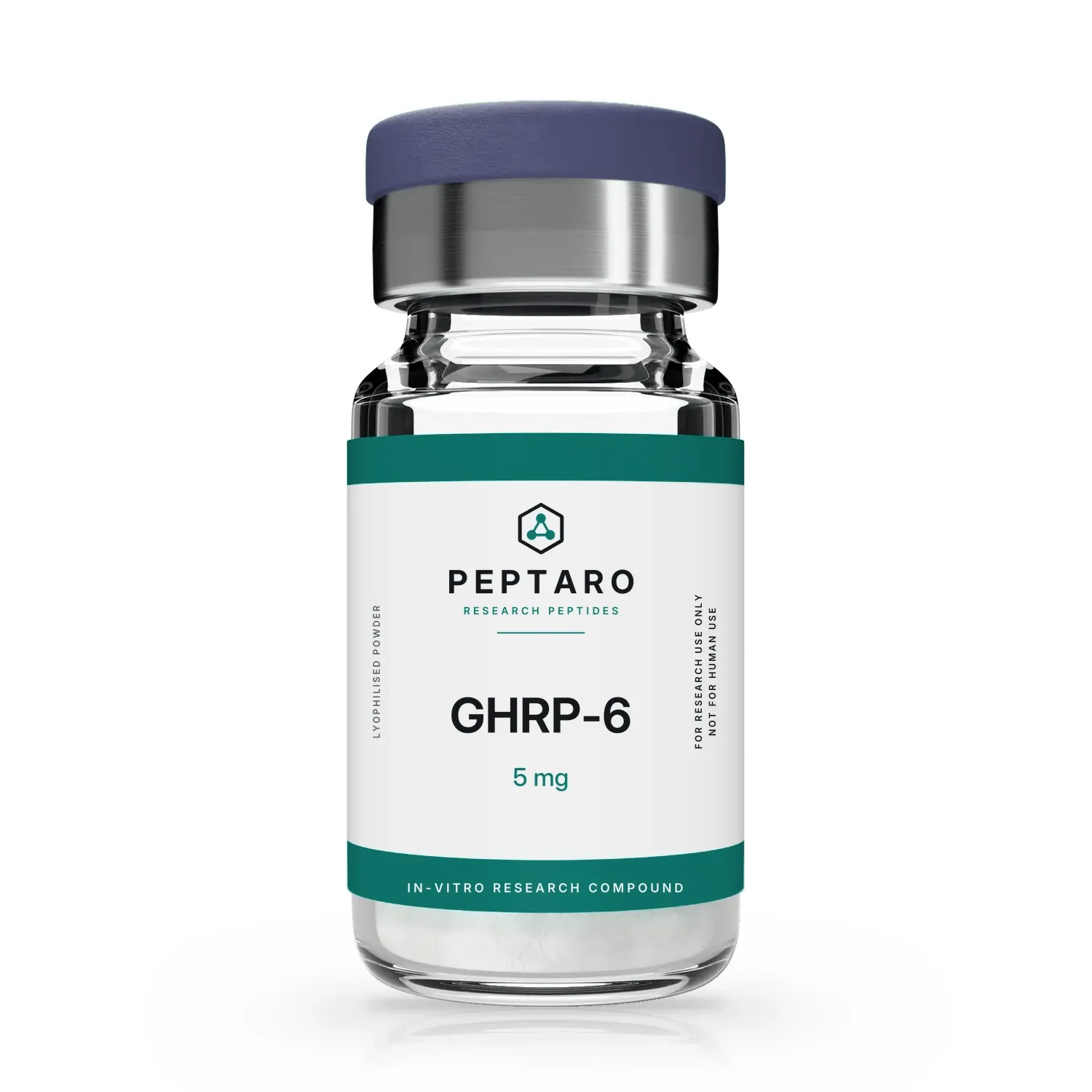
GHRP-6 is a synthetic hexapeptide growth hormone secretagogue and an agonist at the ghrelin/growth hormone secretagogue receptor (GHS-R1a). Research has examined its stimulation of pulsatile growth hormone release at the pituitary somatotroph, its characteristic effect on appetite signalling, and its role as a foundational reference compound in the GHRP peptide family. Supplied as lyophilised powder, supplier-reported analysis, certificate published on this page.
GHRP-6, also written GHRP6, is growth hormone releasing hexapeptide: the first synthetic peptide shown to release growth hormone by acting directly on the pituitary. It activates the ghrelin receptor, GHS-R1a. Each GHRP-6 5mg vial holds white lyophilised powder.
Bowers and colleagues (Endocrinology, 1984) described the hexapeptide His-D-Trp-Ala-Trp-D-Phe-Lys-NH₂. It released growth hormone in isolated pituitary tissue and in rats, monkeys, lambs and calves. It did not release LH, FSH, TSH or prolactin, and somatostatin blocked its effect.
The peptide resembled no known hypothalamic hormone, so its receptor stayed unknown for twelve years. Howard and colleagues (Science, 1996) then cloned GHS-R1a and showed it was the target of the synthetic secretagogues. Its natural ligand, ghrelin, was identified three years later.
GHRP-6 is the founding reference compound in growth hormone secretagogue and ghrelin-receptor research. The Bowers paper set up methods still in use: direct secretagogue activity in isolated pituitary preparations, growth hormone measurement in vivo, and specificity checked against other pituitary hormones. It remains a standard GHS-R1a agonist in receptor-expression systems and binding studies. It is also the usual comparator when newer analogues such as GHRP-2 or ipamorelin are benchmarked. Controlled human data on GHRP-6 are sparse, and it is not an approved therapeutic agent anywhere.
All three act at GHS-R1a and come from the same structure-activity lineage. GHRP-6 is the founding hexapeptide at 873.0 g/mol. GHRP-2 keeps the Ala-Trp-D-Phe-Lys-NH₂ end but swaps His-D-Trp for D-Ala-D-2-Nal, giving 818.0 g/mol. Ipamorelin is a later, shorter pentapeptide designed for more selective growth hormone release. The hunger effect is usually linked to GHRP-6, but the controlled human food-intake study in this class used GHRP-2 (Laferrère et al., 2005). Most comparative claims about the three come from early in-vitro and animal work.
GHRP-6, also written GHRP6 or GHRP 6 and spelt out as growth hormone releasing hexapeptide, is the founding compound of the entire growth hormone secretagogue class. It is a synthetic hexapeptide with the sequence His-D-Trp-Ala-Trp-D-Phe-Lys-NH₂, molecular formula C₄₆H₅₆N₁₂O₆, molecular weight 873.0 g/mol and CAS number 87616-84-0, carrying two D-amino-acid substitutions and two tryptophan residues within its six positions. Its characterisation is a landmark paper: Bowers and colleagues (Endocrinology, 1984) reported the in vitro and in vivo activity of a new synthetic hexapeptide that acts on the pituitary to specifically release growth hormone, specifically meaning that in their hands the peptide released GH without behaving as a general secretagogue for the other pituitary hormones measured, and directly meaning that activity was demonstrable in isolated pituitary preparations rather than requiring an intact hypothalamus. That result posed an obvious question, because GHRP-6 resembled no known hypothalamic hormone: what receptor was it acting on? The answer took twelve years. Howard and colleagues (Science, 1996) used peptides of this class to clone an orphan G-protein-coupled receptor from pituitary and hypothalamus, now known as the growth hormone secretagogue receptor GHS-R1a, and the endogenous ligand, ghrelin, was identified three years after that. Essentially every compound now described as a ghrelin mimetic, GHRP-2, ipamorelin, hexarelin and the small-molecule secretagogues, descends from the structure-activity lineage this hexapeptide started. The honest limits are equally clear: GHRP-6 is not a licensed medicine anywhere, controlled human data are sparse, and the comparative claims that circulate about the GHRPs trace overwhelmingly to early in-vitro and animal work rather than head-to-head human trials. This vial contains 5mg of GHRP-6 as a white lyophilised powder, batch UKPL-782 at 98.8% purity by RP-HPLC with the certificate of analysis published on this page, supplied strictly for in-vitro laboratory research use only.
Keep sealed vials at -20°C, dry and in the dark. After reconstitution, keep the solution at 2-8°C and use it within 4 weeks, or freeze single-use aliquots at -20°C. Light protection matters more for GHRP-6 than for most peptides of its size. Oxidation of the tryptophans at positions 2 and 4 is the likeliest degradation route, so keep vials and solutions foil-wrapped.
Vials are sold on their own, without bacteriostatic water for mixing or other supplies.
How to reconstitute and handle
Bring the vial to room temperature and swab both stoppers with alcohol. Add bacteriostatic water slowly down the inside wall of the vial and swirl gently until dissolved. Do not shake or vortex. Work away from strong direct light, because both tryptophan residues are light-sensitive. The solution should be clear and colourless. Label the vial with the reconstitution date.
For the full method, see the peptide reconstitution guide and the reconstitution calculator.
Published research on GHRP-6 is indexed on PubMed. See our full UK buyer's guide for GHRP-6.
| CAS number | 87616-84-0 |
|---|---|
| Molecular formula | C₄₆H₅₆N₁₂O₆ |
| Molecular weight | 873.0 g/mol |
| Sequence | His-D-Trp-Ala-Trp-D-Phe-Lys-NH₂ |
| Form | Lyophilised powder |
| Appearance | White lyophilised powder |
| Release specification | ≥98.0% |
| Storage | -20°C lyophilised, 2-8°C reconstituted |
Store sealed lyophilised vials at −20 °C, protected from light and moisture. For preparation, aliquoting and storage of reconstituted stock, see the laboratory reconstitution guide and the concentration calculator.
Bowers and colleagues (Endocrinology, 1984) reported that GHRP-6 acts on the pituitary to specifically release growth hormone, with activity demonstrable in isolated pituitary preparations in vitro as well as in vivo. The receptor mediating that activity was cloned twelve years later by Howard and colleagues (Science, 1996) from pituitary and hypothalamus, using peptides of this class as the probe, and is now known as GHS-R1a, the ghrelin receptor. GHRP6 is therefore a synthetic ghrelin-receptor agonist characterised before ghrelin itself was known. These are receptor and secretion findings from the research literature, not evidence of any effect in humans.
Because the entire growth hormone secretagogue field descends from it. The 1984 Bowers paper established that a small synthetic peptide unrelated to any known hypothalamic hormone could act directly on the pituitary to release GH, which implied an unidentified receptor. Peptides of this class were then used by Howard and colleagues (Science, 1996) to clone that receptor, GHS-R1a, and the endogenous ligand, ghrelin, was identified three years later, a celebrated example of reverse pharmacology in which the synthetic tool preceded both the receptor and the hormone.
All three are agonists of the same receptor, GHS-R1a. GHRP-6 is the original Bowers hexapeptide, His-D-Trp-Ala-Trp-D-Phe-Lys-NH₂ at 873.0 g/mol. GHRP-2 replaces the N-terminal His-D-Trp with D-Ala-D-2-Nal and is generally reported in the comparative literature as the more potent GH releaser, at 817.9 g/mol. Ipamorelin is a later pentapeptide designed with the goal of greater selectivity for GH release over other pituitary hormones. Those comparative potency and selectivity claims trace largely to early in-vitro and animal characterisation rather than head-to-head human trials, and should be treated as working distinctions rather than settled fact.
Yes. Growth hormone releasing peptides are named among the growth hormone secretagogues in section S2 of the WADA Prohibited List, with GHRP-6 cited explicitly, and are prohibited at all times, both in and out of competition. Athletes subject to anti-doping testing should treat GHRP6 accordingly.
GHRP-6 may be purchased in the UK as a research chemical for in vitro laboratory use only. It is not an approved or licensed medicine and is not supplied for human consumption, veterinary use, or any therapeutic purpose. Each vial contains 5mg of lyophilised GHRP-6, batch UKPL-782 stated at 98.8% purity by RP-HPLC on a supplier-reported certificate of analysis published on the product page, with independent verification pending. Purchasers must be 18 or over and confirm research-only use at checkout.
Peptaro has GHRP-6 5mg for sale from UK stock, batch UKPL-782. Orders placed before 3pm UK time on a working day go out the same day. UK delivery by Royal Mail Tracked is free on every order.
Not yet. The certificate for batch UKPL-782 is a supplier-reported analysis stating 98.8% purity by RP-HPLC, and independent third-party verification is pending. It is published in full on the product page.
GHRP-6 is used in growth hormone secretagogue and ghrelin-receptor (GHS-R1a) research. Typical systems are isolated pituitary preparations, receptor-expression assays and binding studies. It is also the historical reference agonist for benchmarking newer analogues such as GHRP-2 and ipamorelin.
No. Peptaro supplies GHRP-6 5mg strictly for in-vitro laboratory research. It is not a medicine and is not for human or veterinary use, and we don't give usage advice.
Orders placed by 3pm Monday to Friday (excluding bank holidays) are dispatched the same working day by Royal Mail Tracked 24. Delivery is free, tracked and cold-packed. The minimum order is £299.
5mg
In Stock · Ready to Ship
5mg
In Stock · Ready to Ship
5mg
In Stock · Ready to Ship
5+5mg · 10+10mg
In Stock · Ready to ShipResearch use only. For in-vitro laboratory research use only. Not for human or veterinary use. By continuing you confirm you are 18+ and purchasing for laboratory research.