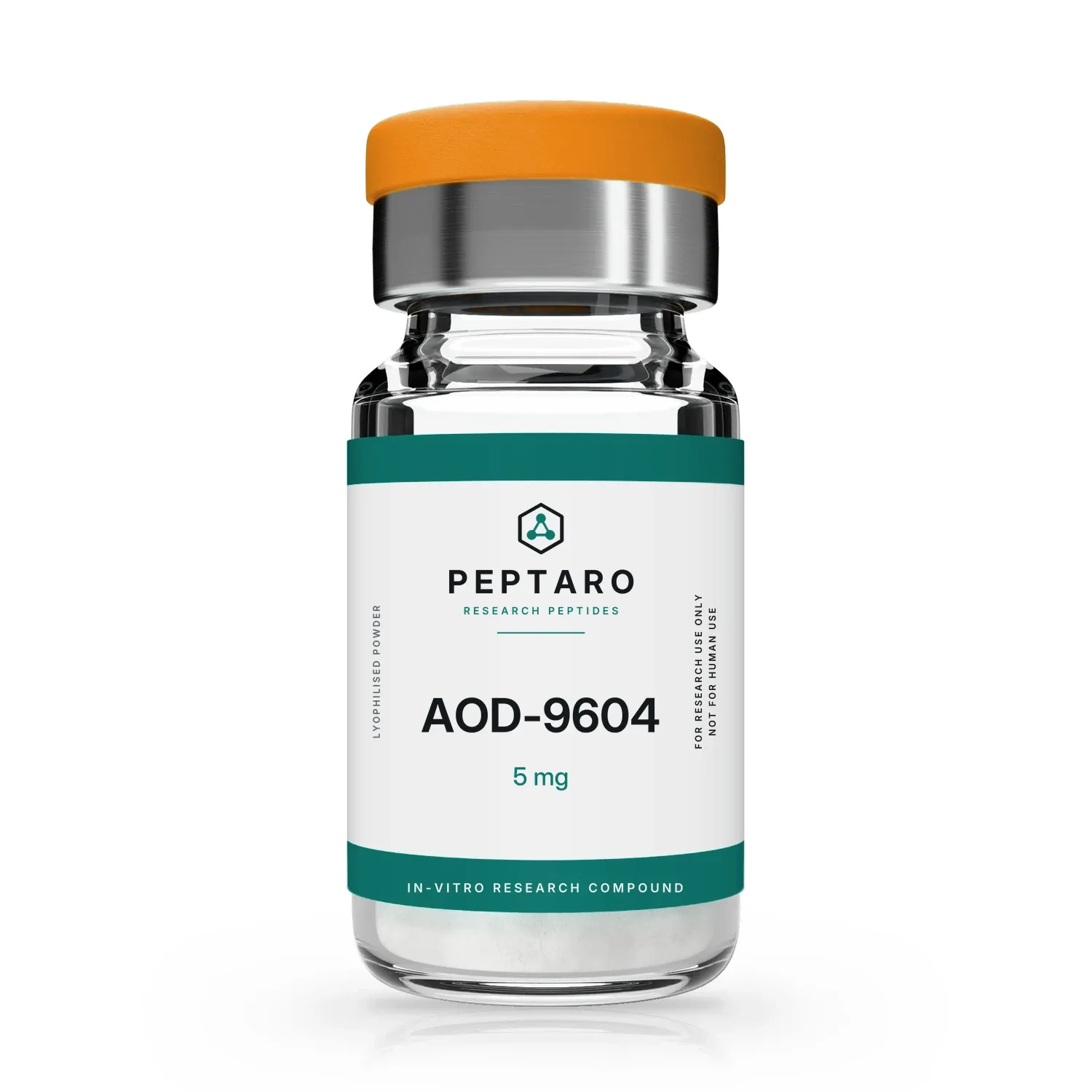
AOD-9604
5mg
In Stock · Ready to Ship£34.99£7.00/mg
98.65% HPLC-UV/MSJanoshikBatch UKPL-740
£34.99£7.00/mg
In Stock · Ready to Ship
Minimum order £299.00 per basket: mix any products. Research kits meet it on their own.
Dispatched same day if ordered by 3pm (Mon–Fri) · Royal Mail Tracked 24
| Vials in basket | Per vial | Saving |
|---|---|---|
| 1–2 | £34.99 | — |
| 3+ | £33.24 | 5% |
| 5+ | £32.19 | 8% |
| 10+ | £30.79 | 12% |
Discounts are basket-wide: mix any vials.
Documentation for each item ships with your order.
For in-vitro laboratory research use only. Not for human or veterinary use.
Documentation for each item ships with your order. The batch number printed on your vial matches it.
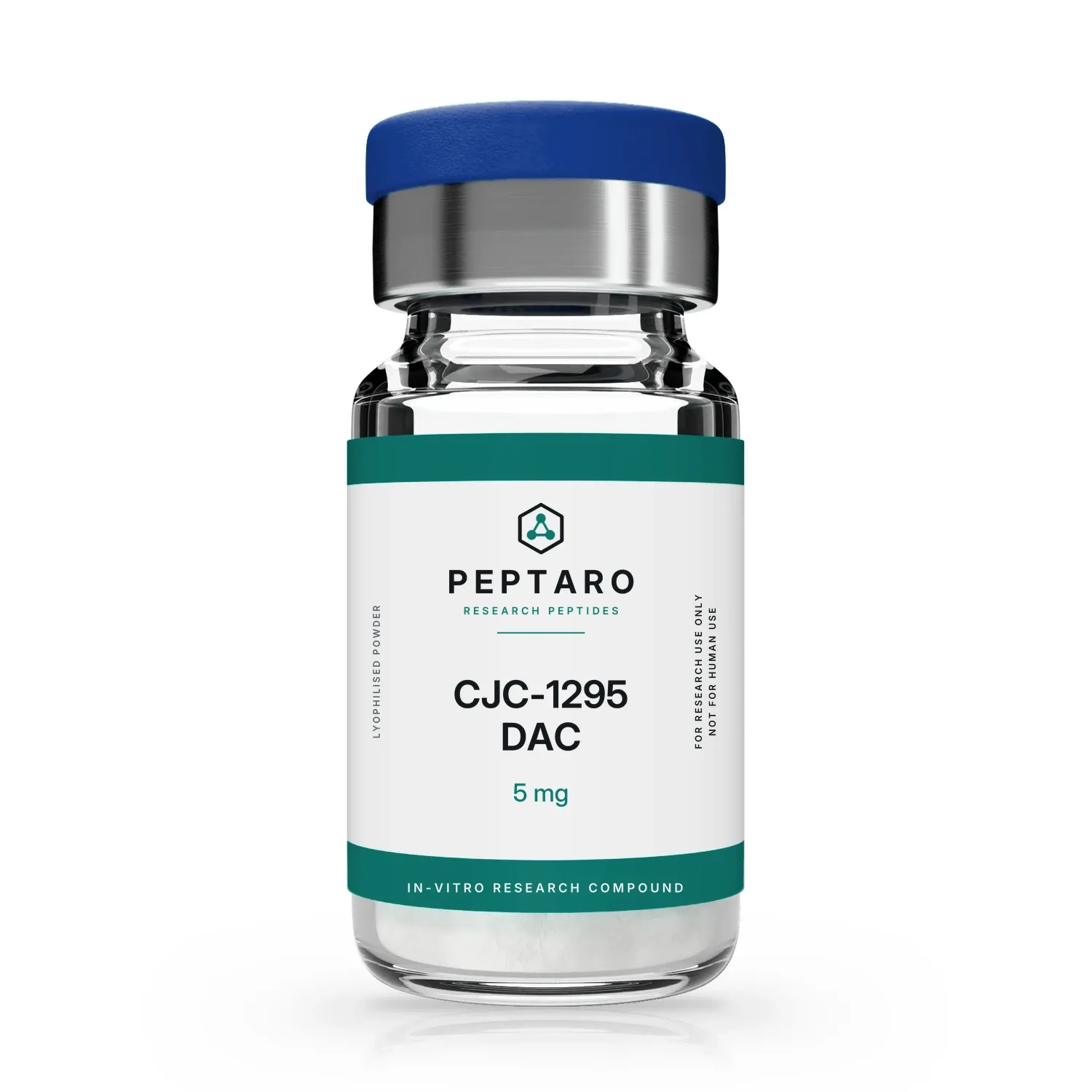
CJC-1295 with DAC (Drug Affinity Complex) is a modified GHRH analogue conjugated with a maleimidopropionic acid linker that allows covalent binding to serum albumin in vivo. The albumin binding extends its plasma half-life substantially compared to the no-DAC variant, sustaining elevated growth hormone and IGF-1 release for an extended period in research models. Lyophilised powder, supplier-reported analysis published on this page.
CJC-1295 DAC (CJC-1295 with DAC) is supplied as a 5mg lyophilised powder. Its maleimide linker binds covalently to serum albumin, which is what stretches the half-life from minutes to days.
It is the tetrasubstituted hGRF(1-29) backbone extended by a thirtieth lysine, whose side-chain amine carries 3-maleimidopropionic acid. In modification nomenclature it is Nε30-maleimidopropionyl-[D-Ala2, Gln8, Ala15, Leu27]-Sermorelin-Lys30. DAC stands for Drug Affinity Complex. The maleimide reacts with Cys34 of serum albumin, the most abundant free thiol in plasma, and forms a covalent thioether conjugate. Teichman et al. (J Clin Endocrinol Metab, 2006) estimated its half-life in healthy adults at 5.8 to 8.1 days. It binds the GHRH receptor on pituitary somatotrophs.
CJC-1295 DAC is studied in endocrine research on GHRH receptor pharmacology, somatotroph biology and sustained versus intermittent receptor stimulation. Albumin conjugation turns a minutes-long agonist into a multi-day one without changing how it binds the receptor.
The two share the same receptor and the same first 29 residues. Everything that separates them sits at the C-terminus. CJC-1295 without DAC, sold as modified GRF (1-29), stops at residue 29: C₁₅₂H₂₅₂N₄₄O₄₂, 3367.9 g/mol, with a half-life of the order of 30 minutes. CJC-1295 with DAC adds Lys30 carrying 3-maleimidopropionic acid, taking the mass to 3647.2 g/mol. The 279.3 difference is one lysine plus one maleimidopropionyl group, which makes mass the simplest check that a vial holds the DAC form.
Choose the no-DAC form when you need short, controllable exposure. Choose the DAC form when sustained receptor occupancy is the variable under study.
CJC-1295 DAC is a 30-residue growth hormone releasing hormone analogue carrying a maleimide group that binds covalently to serum albumin in circulation, molecular formula C₁₆₅H₂₆₉N₄₇O₄₆, molecular weight 3647.2 g/mol, CAS 863288-34-0. In modification nomenclature it is Nε30-maleimidopropionyl-[D-Ala2, Gln8, Ala15, Leu27]-Sermorelin-Lys30, that is the tetrasubstituted hGRF(1-29) backbone extended by a thirtieth residue, lysine, whose side-chain amine carries 3-maleimidopropionic acid. DAC stands for Drug Affinity Complex, and it is the entire reason cjc 1295 dac and cjc dac are searched separately from the no-DAC compound. A maleimide is a Michael acceptor, and the most abundant free thiol in plasma is Cys34 of human serum albumin, so the peptide forms a stable covalent thioether conjugate with albumin after administration rather than binding it reversibly. Jetté and colleagues (Endocrinology, 2005) synthesised three maleimido hGRF(1-29) derivatives, bioconjugated them to albumin and identified CJC-1295 as the long-lasting analogue; Teichman and colleagues (J Clin Endocrinol Metab, 2006) reported a terminal half-life of roughly 6 to 8 days in healthy adults. The four backbone substitutions each remove a degradation liability of native GRF(1-29): D-Ala2 blocks dipeptidyl peptidase-4 cleavage at the Tyr1-Ala2 bond, Gln8 removes an asparagine deamidation site, Leu27 removes a methionine oxidation site, and Ala15 is associated with increased potency. One widely repeated claim about the DAC form is contradicted by the literature. Ionescu and Frohman (J Clin Endocrinol Metab, 2006) reported that pulsatile GH secretion persisted during continuous GHRH-receptor stimulation by CJC-1295, indicating that pulse generation is not set by GHRH pulse frequency alone. Alba and colleagues (Am J Physiol Endocrinol Metab, 2006) examined the analogue in the GHRH knockout mouse.
Store the sealed 5mg vial at -20°C, dry and away from light. Keep reconstituted solution refrigerated at 2-8°C and freeze single-use aliquots for longer holding. Avoid repeated freeze-thaw cycles and prolonged storage of dilute solution at raised pH. Alkaline conditions hydrolyse the maleimide to an unreactive maleamic acid, which destroys the albumin-binding chemistry while the peptide backbone still looks intact by HPLC.
Vials are sold on their own, without bacteriostatic water for mixing or other supplies.
How to reconstitute and handle
Let the vial reach room temperature. Run bacteriostatic water slowly down the inside wall of the vial and swirl gently until clear and colourless. Do not shake or vortex. Keep free thiols out of the preparation: dithiothreitol, beta-mercaptoethanol, free cysteine and reduced glutathione all react with the maleimide. Label the vial with the reconstitution date and refrigerate it.
For the full method, see the peptide reconstitution guide and the reconstitution calculator.
Published research on CJC-1295 DAC is indexed on PubMed. See our full UK buyer's guide for CJC-1295 and UK buyer's guide for CJC-1295 CoA.
| CAS number | 863288-34-0 |
|---|---|
| Molecular formula | C₁₆₅H₂₆₉N₄₇O₄₆ |
| Molecular weight | 3647.2 g/mol |
| Sequence | H-Tyr-D-Ala-Asp-Ala-Ile-Phe-Thr-Gln-Ser-Tyr-Arg-Lys-Val-Leu-Ala-Gln-Leu-Ser-Ala-Arg-Lys-Leu-Leu-Gln-Asp-Ile-Leu-Ser-Arg-Lys(Nε-maleimidopropionyl)-NH₂ |
| Form | Lyophilised powder |
| Appearance | White to off-white lyophilised powder |
| Release specification | ≥98.0% |
| Storage | -20°C lyophilised, 2-8°C reconstituted |
Store sealed lyophilised vials at −20 °C, protected from light and moisture. For preparation, aliquoting and storage of reconstituted stock, see the laboratory reconstitution guide and the concentration calculator.
The difference is one residue and one linker, and it changes the pharmacokinetics by orders of magnitude. CJC-1295 without DAC, also called modified GRF (1-29), is 29 residues, C₁₅₂H₂₅₂N₄₄O₄₂, 3367.9 g/mol, and is cleared within minutes. CJC-1295 with DAC adds Lys30 bearing 3-maleimidopropionic acid, taking the mass to 3647.2 g/mol, a difference of 279.3 corresponding exactly to the lysine plus the maleimidopropionyl group. That maleimide conjugates to albumin and gives the reported terminal half-life of roughly 6 to 8 days. The receptor and the binding site are the same; only the residence time differs.
DAC stands for Drug Affinity Complex. Chemically it is a maleimide, a Michael acceptor that reacts selectively with free sulfhydryl groups, and the most abundant free thiol in plasma is Cys34 of human serum albumin. The peptide therefore forms a stable covalent thioether bond to albumin after administration. This is a genuine covalent conjugation, not the reversible non-covalent albumin binding used by fatty-acid-acylated peptides, and it is why the effect on half-life is so large. Jetté and colleagues (Endocrinology, 2005) demonstrated the bioconjugation and identified CJC-1295 from a set of three maleimido GRF derivatives.
Teichman and colleagues (J Clin Endocrinol Metab, 2006) reported a terminal half-life of approximately 6 to 8 days in healthy adults following single administration, against a half-life of the order of minutes for unmodified GRF(1-29). The extension comes from albumin conjugation, which removes the peptide from renal filtration and gives a long-lived circulating depot. For comparison, the no-DAC modified GRF (1-29) form is generally quoted at around 30 minutes.
The published data say otherwise, and this is the most useful thing to know about the compound. Ionescu and Frohman (J Clin Endocrinol Metab, 2006) specifically examined whether continuous GHRH-receptor stimulation abolishes pulsatility and reported that pulsatile GH secretion persisted during continuous stimulation by CJC-1295. The implication is that GH pulse generation is not driven by GHRH pulse frequency alone, so the common framing of DAC as producing a non-physiological flat profile and no-DAC as the only pulsatile option is an oversimplification of the literature.
Yes, GHRH analogues and growth hormone secretagogues are routinely studied in combination because they act at different receptors. CJC-1295 DAC binds the GHRH receptor, while Ipamorelin is a selective agonist at GHS-R1a, the ghrelin receptor, and the two pathways converge on the somatotroph. Researchers designing such work should note that the DAC form's multi-day residence time makes the two compounds' pharmacokinetics very different, which matters for how a combined protocol is interpreted. No dosing guidance is offered here; all material is supplied for laboratory research only.
Peptaro supplies research-grade CJC-1295 DAC 5mg in the UK, batch UKPL-740 at 98.65% purity by HPLC on a supplier-reported analysis, with the certificate of analysis published on this product page and independent verification pending, and same-day UK dispatch on orders placed before 3pm UK time. free tracked UK delivery on every order. The no-DAC modified GRF (1-29) form is listed separately. Supplied for in-vitro laboratory research only, purchasers must be 18 or over.
Check the mass. CJC-1295 DAC is 3647.2 g/mol and the no-DAC modified GRF (1-29) is 3367.9 g/mol. A mass spectrometry result near 3368 on a vial sold as DAC means it holds the short-acting peptide. Our batch UKPL-740 showed [M+H]+ at 3648.2 m/z, matching the DAC form, with 98.65% purity by HPLC.
CJC-1295 DAC is used in preclinical endocrine research on GHRH receptor activation, somatotroph pharmacology and sustained versus pulsatile receptor stimulation. It is also a working example of albumin bioconjugation chemistry for extending peptide half-life.
No. Peptaro supplies CJC-1295 DAC 5mg strictly for in-vitro laboratory research. It is not a medicine and is not for human or veterinary use, and we don't give usage advice.
-20°C lyophilised, 2-8°C reconstituted. For preparing and aliquoting stock solutions, see the laboratory reconstitution guide.
Orders placed by 3pm Monday to Friday (excluding bank holidays) are dispatched the same working day by Royal Mail Tracked 24. Delivery is free, tracked and cold-packed. The minimum order is £299.
5mg
In Stock · Ready to Ship
5mg
In Stock · Ready to Ship
5+5mg · 10+10mg
In Stock · Ready to Ship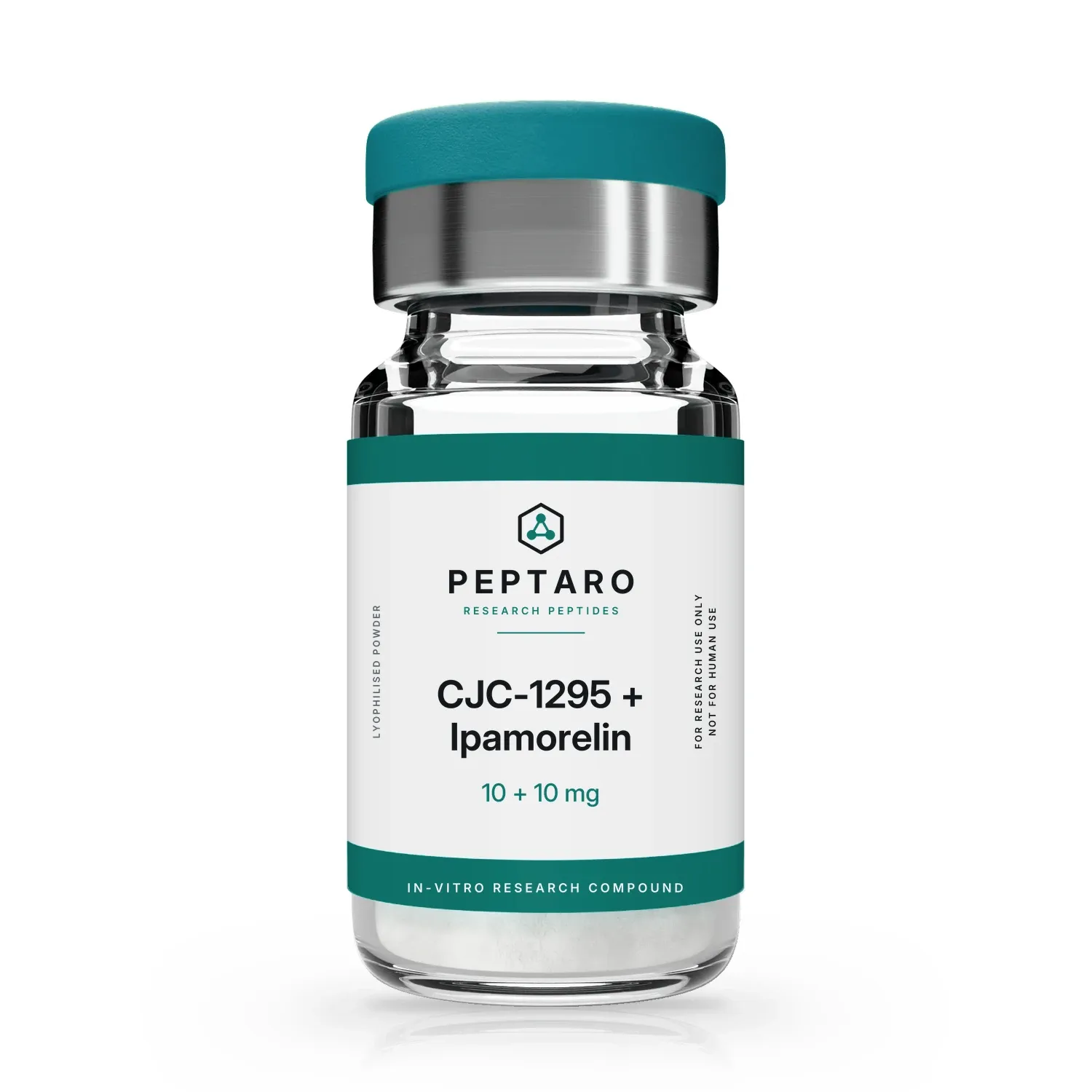
5+5mg · 10+10mg
In Stock · Ready to ShipResearch use only. For in-vitro laboratory research use only. Not for human or veterinary use. By continuing you confirm you are 18+ and purchasing for laboratory research.