AOD-9604
5mg
In Stock · Ready to Ship£34.99£7.00/mg
98.45% RP-HPLCJanoshik AnalyticalBatch UKPL-9425
£24.99£5.00/mg
In Stock · Ready to Ship
Minimum order £299.00 per basket: mix any products. Research kits meet it on their own.
Dispatched same day if ordered by 3pm (Mon–Fri) · Royal Mail Tracked 24
| Vials in basket | Per vial | Saving |
|---|---|---|
| 1–2 | £24.99 | — |
| 3+ | £23.74 | 5% |
| 5+ | £22.99 | 8% |
| 10+ | £21.99 | 12% |
Discounts are basket-wide: mix any vials.
Documentation for each item ships with your order.
For in-vitro laboratory research use only. Not for human or veterinary use.
Documentation for each item ships with your order. The batch number printed on your vial matches it.
CJC-1295 (no DAC) is a synthetic analogue of growth hormone-releasing hormone (GHRH), consisting of 29 amino acids. Research has studied its ability to increase plasma growth hormone and IGF-1 levels through sustained pulsatile release. The D-Ala modification at position 2 gives it a longer half-life than native GHRH. Often paired with Ipamorelin in GH secretagogue research. Supplied as lyophilised powder, third-party tested, lab certificate published on this page.
CJC-1295 without DAC, also sold as modified GRF (1-29) or Mod GRF 1-29, is a 29 amino acid analogue of growth hormone releasing hormone. It acts at the GHRH receptor on pituitary somatotrophs. We supply it as a 5mg vial of lyophilised powder.
Compared with native GHRH (1-29), CJC-1295 without DAC carries four substitutions: D-Ala2, Gln8, Ala15 and Leu27. The formula is C₁₅₂H₂₅₂N₄₄O₄₂, the molecular weight 3367.9 g/mol and the CAS number 863288-34-0.
Plasma dipeptidyl peptidase IV inactivates native GHRH by cutting the bond between residues 2 and 3. A D-amino acid at position 2 blocks that cut (Frohman et al., J Clin Invest, 1989). The code CJC-1295 first named ConjuChem's DAC-bearing molecule. Sellers now use it for both forms, so check the mass on the certificate.
CJC-1295 without DAC is used in GHRH receptor pharmacology, somatotroph cell studies and GH release kinetics. It is the usual GHRH-side partner in two-receptor designs with a ghrelin-receptor agonist such as ipamorelin. The human studies cited here used the DAC form, so check which molecule a paper used.
Both share the tetrasubstituted GRF (1-29) chain and act at the GHRH receptor. The DAC form adds a C-terminal lysine carrying a maleimidopropionamide group, which binds Cys34 of serum albumin. In rats that conjugate was still in plasma after 72 hours (Jetté et al., Endocrinology, 2005).
In healthy adults the DAC form had a half-life of 5.8 to 8.1 days (Teichman et al., 2006). GH secretion stayed pulsatile under that continuous stimulation, with trough levels up 7.5-fold (Ionescu and Frohman, 2006). The no-DAC form has no albumin anchor, so it suits short, pulse-like stimulation. At 3647.2 against 3367.9 g/mol, mass spectrometry tells the two apart.
CJC-1295 (no DAC) is a synthetic analogue of growth hormone releasing hormone (GHRH), also referred to as modified GRF 1-29. It binds to GHRH receptors in the anterior pituitary gland to stimulate the synthesis and secretion of growth hormone. The no DAC (Drug Affinity Complex) version lacks the maleimidopropionic acid linker present in CJC-1295 with DAC, resulting in a shorter half-life that produces more pulsatile GH release patterns. Researchers consider this pulsatile pattern more physiologically similar to natural endogenous GH secretion, making CJC-1295 no DAC particularly valuable for studies requiring physiological GH release kinetics. The compound is frequently studied in combination with Ipamorelin, a selective GHS-R1a agonist, for synergistic effects through complementary receptor pathways, CJC-1295 stimulating GH release via the GHRH receptor while Ipamorelin acts at the ghrelin receptor. This dual-pathway approach produces amplified GH pulses and has become a standard research protocol in growth hormone biology. Studies have examined CJC-1295's effects on plasma GH levels, IGF-1 production, body composition, and sleep-related GH secretion patterns.
The naming around this compound is genuinely confused across the research-chemical market and is worth untangling, because it affects which papers actually apply. CJC-1295 as originally developed by ConjuChem was the DAC-bearing molecule, the drug affinity complex being the defining feature of the compound that carried that code. What is universally sold as “CJC-1295 without DAC” is more accurately tetrasubstituted GRF(1-29), a GHRH fragment carrying D-Ala at position 2, Gln at 8, Ala at 15 and Leu at 27. The substitution that does the real work is D-Ala2, which blocks cleavage by dipeptidyl peptidase-4, the protease that degrades native GHRH within minutes.
The practical consequence is that a good deal of literature cited for “CJC-1295 no DAC” is in fact about the DAC molecule, about mod GRF(1-29), or about native GHRH. Teichman and colleagues (J Clin Endocrinol Metab, 2006), the most frequently cited clinical work, studied the DAC-bearing version, whose sustained albumin-bound profile is not the pulsatile profile this vial produces. Researchers reading around the compound should check which molecule a given paper actually used.
Neither version holds a marketing authorisation in any jurisdiction; ConjuChem's clinical programme did not reach approval.
Store CJC-1295 powder at -20°C, away from light and moisture, for up to 24 months. After reconstitution, keep the solution at 2-8°C and use it within 4 weeks. For longer storage, freeze single-use aliquots at -20°C and avoid repeated freeze-thaw cycles.
Vials are sold on their own, without bacteriostatic water for mixing or other supplies.
How to reconstitute and handle
Let the vial and the bacteriostatic water reach room temperature and swab both stoppers with alcohol. Add the water slowly down the inside wall of the vial and swirl gently until dissolved. Do not shake or vortex. The solution should be clear and colourless.
For the full method, see the peptide reconstitution guide and the reconstitution calculator.
Published research on CJC-1295 is indexed on PubMed. See our full UK buyer's guide for CJC-1295 and UK buyer's guide for CJC-1295 CoA.
| CAS number | 863288-34-0 |
|---|---|
| Molecular formula | C₁₅₂H₂₅₂N₄₄O₄₂ |
| Molecular weight | 3367.9 g/mol |
| Sequence | Tyr-D-Ala-Asp-Ala-Ile-Phe-Thr-Gln-Ser-Tyr-Arg-Lys-Val-Leu-Ala-Gln-Leu-Ser-Ala-Arg-Lys-Leu-Leu-Gln-Asp-Ile-Leu-Ser-Arg-NH₂ |
| Form | White to off-white lyophilised powder |
| Release specification | ≥98.0% |
Store sealed lyophilised vials at −20 °C, protected from light and moisture. For preparation, aliquoting and storage of reconstituted stock, see the laboratory reconstitution guide and the concentration calculator.
CJC-1295 (no DAC) is a GHRH analogue studied for its ability to stimulate pulsatile growth hormone release. It produces GH pulses that closely mimic natural physiological secretion. It is most commonly researched in combination with Ipamorelin for synergistic GH release.
CJC-1295 with DAC (Drug Affinity Complex) binds to serum albumin, extending the half-life to approximately 6-8 days and producing sustained GH elevation. CJC-1295 without DAC (Mod GRF 1-29) has a shorter half-life of approximately 30 minutes, producing pulsatile GH release that more closely mimics natural secretion patterns.
CJC-1295 and Ipamorelin activate complementary receptor pathways for synergistic GH release. CJC-1295 binds GHRH receptors to stimulate GH synthesis, while Ipamorelin binds GHS-R1a (ghrelin receptors) to amplify the GH pulse. The combined effect produces greater GH secretion than either compound alone.
Each vial contains CJC-1295 (no DAC) lyophilised powder (freeze-dried for stability). CJC-1295 has a molecular weight of 3367.9 g/mol with the molecular formula C₁₅₂H₂₅₂N₄₄O₄₂. This compound is supplied for research use only.
You can buy CJC-1295 online from Peptaro. The no-DAC 5mg vial is for sale from UK stock, alongside CJC-1295 DAC and the CJC-1295 + Ipamorelin blend. Orders placed before 3pm (UK time) on a working day are dispatched the same day. tracked UK delivery is free on every order.
Yes. Janoshik Analytical tested batch UKPL-9425 at 98.450% purity by RP-HPLC, against a 98.0% specification. The certificate is published with the product, so you can match it to the batch number on your vial.
Studies of GHRH receptor activation, somatotroph biology and the timing of GH release. Many designs pair it with ipamorelin to drive both GH-releasing receptors at once.
No. Peptaro supplies CJC-1295 5mg strictly for in-vitro laboratory research. It is not a medicine and is not for human or veterinary use, and we don't give usage advice.
Store sealed lyophilised vials at −20 °C, protected from light and moisture. For preparing and aliquoting stock solutions, see the laboratory reconstitution guide.
Orders placed by 3pm Monday to Friday (excluding bank holidays) are dispatched the same working day by Royal Mail Tracked 24. Delivery is free, tracked and cold-packed. The minimum order is £299.
5mg
In Stock · Ready to Ship
5mg
In Stock · Ready to Ship
5+5mg · 10+10mg
In Stock · Ready to Ship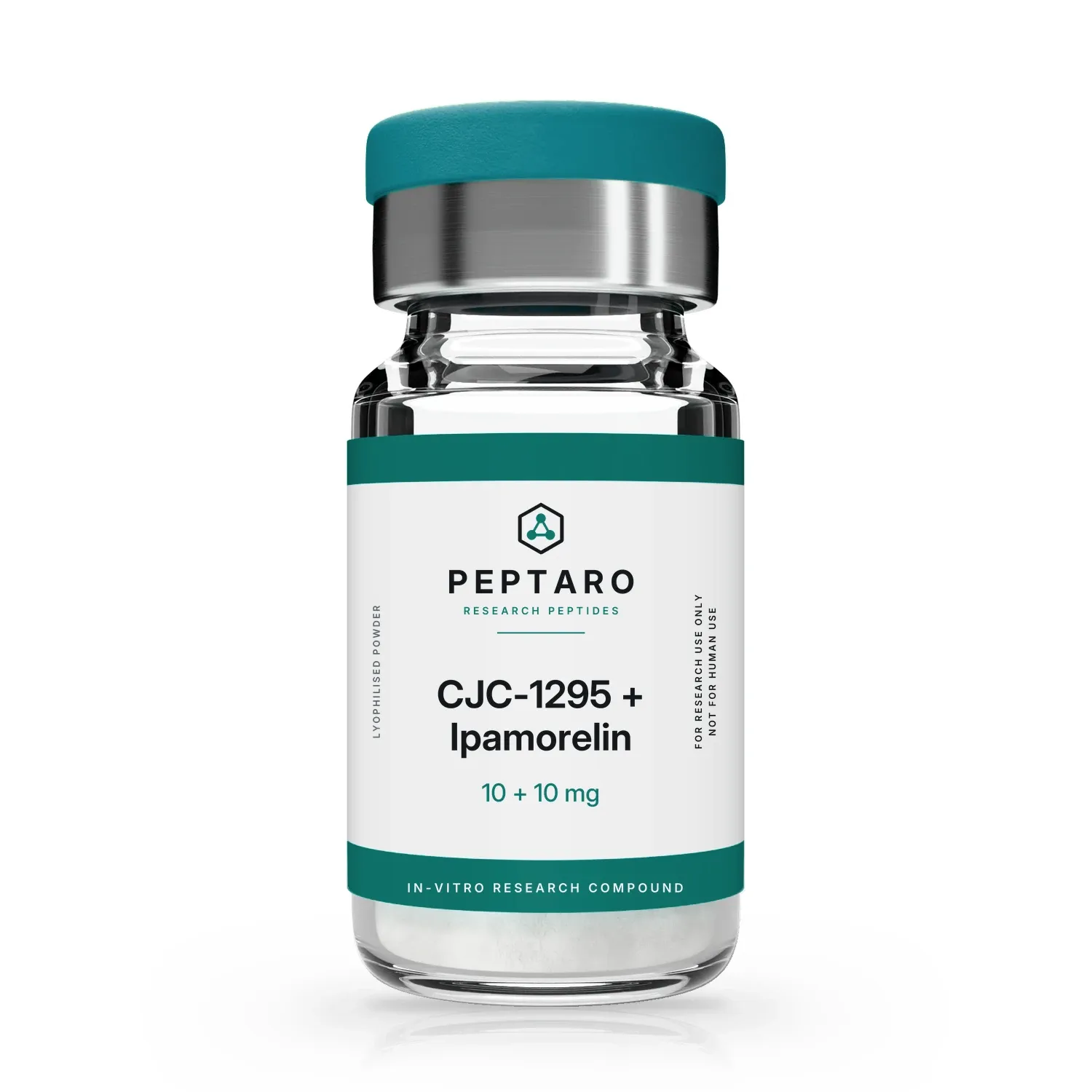
5+5mg · 10+10mg
In Stock · Ready to ShipResearch use only. For in-vitro laboratory research use only. Not for human or veterinary use. By continuing you confirm you are 18+ and purchasing for laboratory research.