AOD-9604
5mg
In Stock · Ready to Ship£34.99£7.00/mg
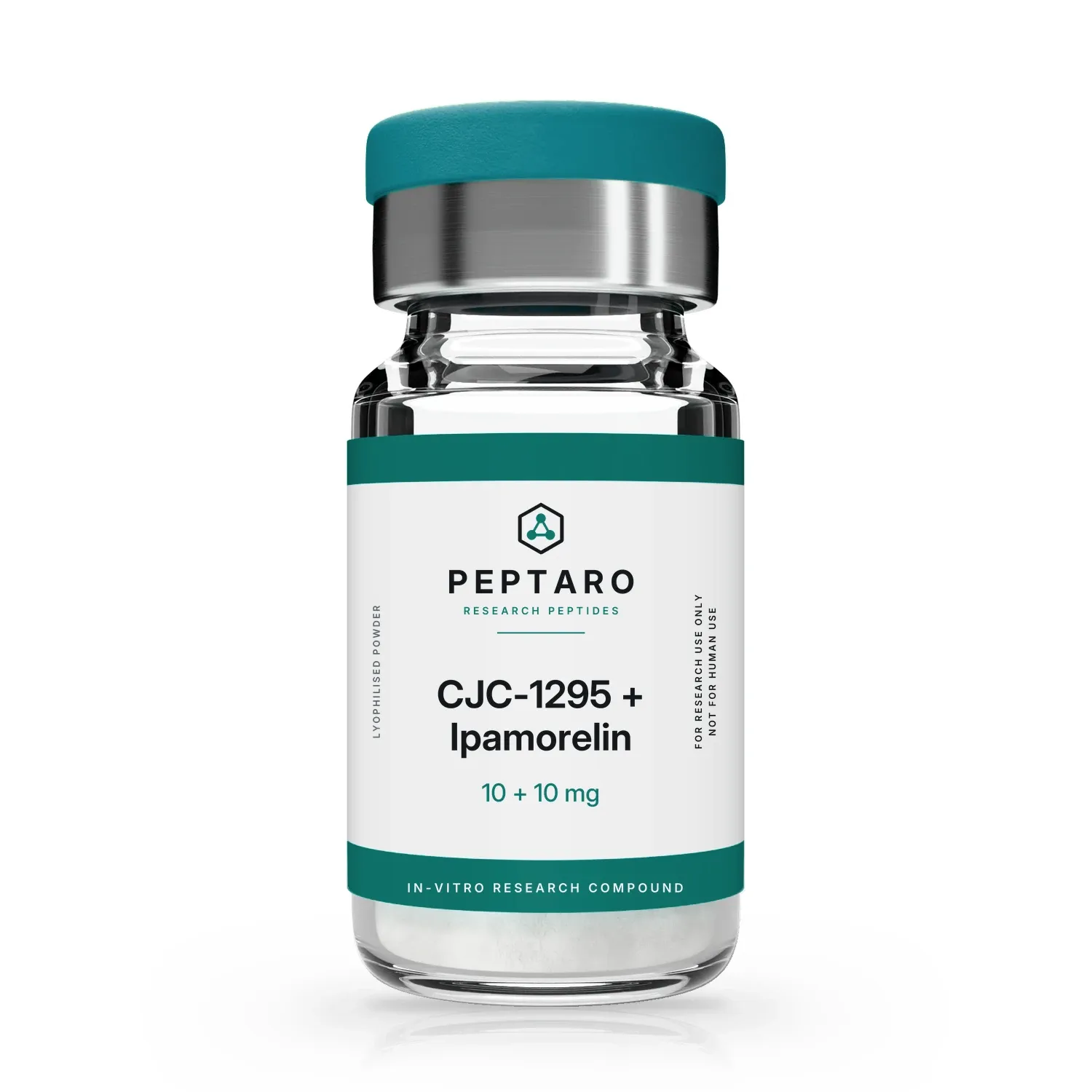
£59.99£3.00/mg
In Stock · Ready to Ship
Minimum order £299.00 per basket: mix any products. Research kits meet it on their own.
Dispatched same day if ordered by 3pm (Mon–Fri) · Royal Mail Tracked 24
| Vials in basket | Per vial | Saving |
|---|---|---|
| 1–2 | £59.99 | — |
| 3+ | £56.99 | 5% |
| 5+ | £55.19 | 8% |
| 10+ | £52.79 | 12% |
Discounts are basket-wide: mix any vials.
Documentation for each item ships with your order.
For in-vitro laboratory research use only. Not for human or veterinary use.
Documentation for each item ships with your order. The batch number printed on your vial matches it.
This blend pairs CJC-1295, a modified GHRH(1-29) analogue, with ipamorelin (Aib-His-D-2-Nal-D-Phe-Lys-NH2), a selective ghrelin-receptor agonist, in a 10+10mg presentation. The two classes are frequently co-studied for their complementary signalling at the GHRH and ghrelin receptors. Supplied as lyophilised powder, supplier-tested, with the certificate published on this page and independent third-party verification pending.
CJC-1295 + Ipamorelin 10+10mg is a pre-blended vial holding 10mg of CJC-1295 without DAC and 10mg of ipamorelin, 20mg of lyophilised peptide in total. It is also written CJC1295/ipamorelin. The larger vial suits longer series than the 5+5mg blend.
CJC-1295 without DAC, also called modified GRF (1-29), is a GHRH (1-29) analogue with four substitutions. It acts at the GHRH receptor on pituitary somatotrophs. Ipamorelin is the pentapeptide Aib-His-D-2-Nal-D-Phe-Lys-NH₂, a selective agonist at the ghrelin receptor, GHS-R1a. The two receptors sit on the same cell but signal differently, which is why the pair is the standard two-receptor design in growth hormone release research.
Equal mass is far from equal moles. At 3367.9 and 711.9 g/mol, 10mg of each is about 3.0 µmol of CJC-1295 against 14.0 µmol of ipamorelin, roughly 4.7 to 1 in favour of ipamorelin.
Typical preclinical uses are dual-receptor somatotroph stimulation, pulsatile growth hormone release kinetics with both inputs applied together, and downstream IGF-1 axis work. The fixed mass ratio removes ratio-preparation error, and one batch covers a whole replicate series.
The two vials are the same blend at different mass. Both hold the peptides at a 1:1 mass ratio, so a design built on the 5+5mg vial transfers without any change in stoichiometry. The 10+10mg vial holds 20mg in total. That means fewer vials and reconstitutions across a replicate series, and one certificate covering more material. Designs that need independent concentrations, a single-agent control arm or attribution to one receptor need the separate vials.
This is a single lyophilised vial co-formulating two growth hormone secretagogues at higher mass than the original format: CJC-1295 10mg and Ipamorelin 10mg, 20mg of total peptide per vial. CJC-1295 is a modified GHRH(1-29) analogue (CAS 863288-34-0, 3647.8 g/mol) that signals at the GHRH receptor on the pituitary somatotroph, while Ipamorelin is a pentapeptide (Aib-His-D-2-Nal-D-Phe-Lys-NH₂, CAS 170851-70-4, 711.85 g/mol) acting as a selective agonist at the ghrelin receptor GHS-R1a. The two receptors converge on the same cell through different second-messenger pathways, which is why the two classes are frequently co-studied for complementary signalling rather than treated as alternatives to one another.
The pairing rests on two separate single-agent literatures plus a general synergy literature. On the GHRH side, the defining human pharmacology is Teichman and colleagues (J Clin Endocrinol Metab, 2006), who reported dose-dependent increases in plasma growth hormone and IGF-I after CJC-1295 in healthy adults. On the ghrelin side, Raun and colleagues (Eur J Endocrinol, 1998) characterised Ipamorelin as the first growth hormone secretagogue with selectivity for growth hormone release approaching that of GHRH itself, without the ACTH and cortisol elevation seen with earlier compounds in the class. The receptor itself was cloned and shown to be the target of the synthetic secretagogues by Howard and colleagues (Science, 1996). Class-level combination designs trace to Bowers and colleagues (J Clin Endocrinol Metab, 1990), who showed a GHRP acting with GHRH produced a greater combined response than either alone.
The 10+10mg presentation differs from the 5+5mg vial in mass per vial, not in chemistry. Both carry the components at a fixed 1:1 mass ratio, which is far from equimolar: the GHRH analogue is the larger molecule, so each vial holds roughly 14 µmol of ipamorelin against 2.7 µmol of CJC-1295. Doubling the mass doubles both sides of that ratio, leaving the stoichiometry unchanged; what the larger format changes is laboratory logistics, one vial covering longer replicate series with one batch and one certificate. The honest caveat is unchanged as well: no controlled study of this specific blend has been published.
Keep sealed vials at -20°C, away from light and moisture. After reconstitution, keep the solution at 2-8°C and use it within 4 weeks, or freeze single-use aliquots at -20°C. The GHRH analogue is the less stable partner and sets the in-use window for the whole vial, so aliquot at reconstitution.
Vials are sold on their own, without bacteriostatic water for mixing or other supplies.
How to reconstitute and handle
Treat the vial as one 20mg preparation, with the fill volume set by the concentration your protocol needs. Let the vial and the bacteriostatic water reach room temperature and swab both stoppers. Add the water slowly down the inside wall and swirl gently until dissolved. Do not shake or vortex: the GHRH-class peptide is the shear-sensitive partner. The solution should be clear and colourless. The peptides cannot be separated afterwards. Label the vial with fill volume, concentration and date.
For the full method, see the peptide reconstitution guide and the reconstitution calculator.
Published research on CJC-1295 + Ipamorelin is indexed on PubMed.
| CAS number | 863288-34-0 / 170851-70-4 |
|---|---|
| Molecular formula | C₁₅₂H₂₅₂N₄₄O₄₂ / C₃₈H₄₉N₉O₅ |
| Molecular weight | 3367.9 / 711.9 g/mol (CJC-1295 no DAC / ipamorelin) |
| Form | Lyophilised powder (single vial) |
| Storage | -20°C lyophilised, 2-8°C reconstituted |
Store sealed lyophilised vials at −20 °C, protected from light and moisture. For preparation, aliquoting and storage of reconstituted stock, see the laboratory reconstitution guide and the concentration calculator.
One lyophilised vial containing 10mg of CJC-1295, a modified GHRH(1-29) analogue (CAS 863288-34-0, 3647.8 g/mol), and 10mg of Ipamorelin, a selective ghrelin-receptor agonist (CAS 170851-70-4, 711.85 g/mol), 20mg of total peptide. Current batch UKPL-9515, tested by Janoshik Analytical (test #244688, 26 October 2026) with each component quantified separately, and the certificate is published on this page.
They act at two different receptors on the same pituitary somatotroph. CJC-1295 is a GHRH(1-29) analogue signalling at the GHRH receptor, while Ipamorelin is a selective agonist at the ghrelin receptor GHS-R1a, the receptor cloned by Howard and colleagues (Science, 1996). Because the targets are distinct, combination designs following Bowers and colleagues (J Clin Endocrinol Metab, 1990) report a greater combined response than either class alone, which is why the pairing is a standard two-receptor design in growth hormone release research.
Mass per vial, not chemistry. Both formats hold the same 1:1 mass ratio of the same two compounds, so reconstituted stoichiometry is identical. The 10+10mg vial holds 20mg of total peptide, double the 5+5mg format, and is the practical choice for replicate series that need more blend per batch. If a design needs to vary the ratio or run a single component alone, the individual CJC-1295 and Ipamorelin vials are stocked separately.
Selectivity is Ipamorelin's defining property in the literature. Raun and colleagues (Eur J Endocrinol, 1998) reported growth hormone release without the ACTH and cortisol elevation that accompanies earlier growth hormone releasing peptides such as GHRP-6 and hexarelin, describing selectivity comparable to GHRH itself. That profile is why ipamorelin is the ghrelin-receptor compound most often chosen for combination work.
The blend is the convenient option when both compounds are wanted at the fixed 1:1 mass ratio, with the 10+10mg format covering longer series from one vial and one certificate. Because both components go into solution together, the ratio cannot be changed after reconstitution, so any design needing independent concentrations, a single-agent control arm, or receptor-level attribution requires the separate CJC-1295 and Ipamorelin vials, which we also stock.
You can buy CJC-1295 and ipamorelin online from Peptaro: the 10+10mg vial is for sale from UK stock, batch UKPL-9515. Orders placed before 3pm UK time on a working day are dispatched the same day. tracked UK delivery is free on every order.
Yes. Batch UKPL-9515 was tested by Janoshik Analytical (test #244688, 26 October 2026), and the certificate is published on the product page. It reports each peptide separately: 10.37mg CJC-1295 (no DAC) and 11.02mg ipamorelin against 10mg label claims.
Choose by how much blend your design uses. Both have the same 1:1 mass ratio. The 10+10mg vial suits longer replicate series with fewer reconstitutions, and the 5+5mg vial is the smaller commitment. To vary the ratio or run one peptide alone, use the single CJC-1295 and ipamorelin vials.
No. Peptaro supplies CJC-1295 + Ipamorelin 10+10mg strictly for in-vitro laboratory research. It is not a medicine and is not for human or veterinary use, and we don't give usage advice.
-20°C lyophilised, 2-8°C reconstituted. For preparing and aliquoting stock solutions, see the laboratory reconstitution guide.
Orders placed by 3pm Monday to Friday (excluding bank holidays) are dispatched the same working day by Royal Mail Tracked 24. Delivery is free, tracked and cold-packed. The minimum order is £299.
5mg
In Stock · Ready to Ship
5mg
In Stock · Ready to Ship
5mg
In Stock · Ready to Ship
5mg
In Stock · Ready to ShipResearch use only. For in-vitro laboratory research use only. Not for human or veterinary use. By continuing you confirm you are 18+ and purchasing for laboratory research.