DSIP
5mg · 10mg
In Stock · Ready to Shipfrom £13.95from £2.79/mg
99.2% RP-HPLC (UV)JanoshikBatch UKPL-472
£39.99£8.00/mg
In Stock · Ready to Ship
Minimum order £299.00 per basket: mix any products. Research kits meet it on their own.
Dispatched same day if ordered by 3pm (Mon–Fri) · Royal Mail Tracked 24
| Vials in basket | Per vial | Saving |
|---|---|---|
| 1–2 | £39.99 | — |
| 3+ | £37.99 | 5% |
| 5+ | £36.79 | 8% |
| 10+ | £35.19 | 12% |
Discounts are basket-wide: mix any vials.
Documentation for each item ships with your order.
For in-vitro laboratory research use only. Not for human or veterinary use.
Documentation for each item ships with your order. The batch number printed on your vial matches it.
Adamax is a synthetic analogue of Semax, extending the ACTH(4-10)-derived heptapeptide sequence with two additional residues and an acetylated N-terminus, giving Ac-Met-Glu-His-Phe-Pro-Gly-Pro-Ala-Gly. N-terminal acetylation is a standard strategy for reducing aminopeptidase cleavage, and the extended sequence distinguishes it from Semax itself. Note that although the compound is frequently marketed as adamantane-modified, the molecular formula reported for it, C50H69N11O11S, contains no adamantane group, and no CAS number has been formally assigned: several conflicting registry numbers circulate between suppliers, one of which is in fact the registry number for Semax. Independent published research on this specific analogue is minimal. Supplied as lyophilised powder for research use only.
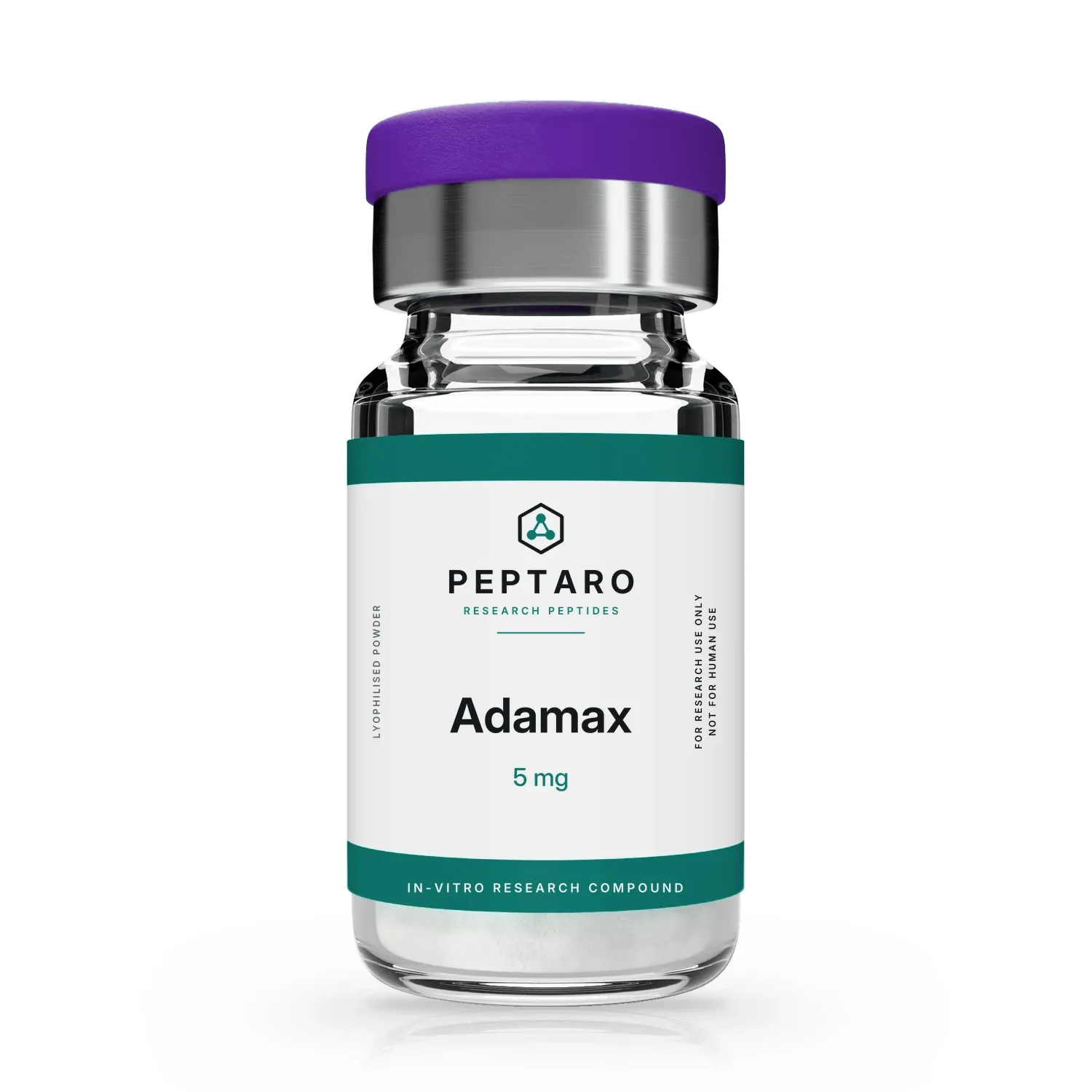
Adamax is a synthetic nine-residue analogue of Semax, sequence Ac-Met-Glu-His-Phe-Pro-Gly-Pro-Ala-Gly. It adds an N-terminal acetyl group and a C-terminal Ala-Gly to the Semax heptapeptide. Each Adamax 5mg vial holds white lyophilised powder.
Semax itself is Met-Glu-His-Phe-Pro-Gly-Pro: the ACTH(4-7) fragment of adrenocorticotropin extended by Pro-Gly-Pro. N-terminal acetylation is a standard way to slow aminopeptidase cleavage, and the Ala-Gly tail makes Adamax a distinct molecule.
Adamax has no published peer-reviewed pharmacology of its own. There are no binding studies, cell studies, animal studies or toxicology data on it in the indexed literature. Every mechanistic statement below comes from the parent Semax literature and is labelled as such.
There are no published research applications specific to Adamax. Its use is in analogue-versus-parent designs with Semax as the reference arm. Examples are proteolytic stability assays in serum or tissue homogenate, side-by-side BDNF and trkB endpoint assays in neuronal culture, and analytical characterisation of the analogue itself.
Semax is the characterised compound. Dolotov and colleagues (J Neurochem, 2006) found specific, reversible, calcium-dependent Semax binding sites in rat basal forebrain membranes, with BDNF protein rising in that region. In rat hippocampus, the same group (Brain Res, 2006) reported a 1.4-fold rise in BDNF protein and more trkB activation after a single application. Adamax is the uncharacterised analogue. Whether acetylation makes it more stable than Semax, or whether the parent's BDNF findings carry over, has not been tested. Researchers who need an evidenced compound should choose Semax.
Adamax, often described simply as a Semax analogue, is a synthetic N-acetylated nonapeptide built on the Semax scaffold, with the sequence Ac-Met-Glu-His-Phe-Pro-Gly-Pro-Ala-Gly and a stated molecular weight of 1032.2 g/mol. Its parent compound, Semax, is the heptapeptide Met-Glu-His-Phe-Pro-Gly-Pro, the ACTH(4-7) fragment of adrenocorticotropin extended by the C-terminal tripeptide Pro-Gly-Pro. Adamax modifies that scaffold at both ends, carrying an N-terminal acetyl group and a C-terminal Ala-Gly extension, and it has no CAS registry number of its own. The most important fact about Adamax is what the literature does not contain: there is essentially no published, peer-reviewed pharmacology on the compound itself. No binding studies, no in-vitro characterisation, no animal work and no toxicology on Adamax appear in the indexed literature, and this page states that plainly rather than borrowing evidence by implication. Everything said mechanistically about it is inference from the parent Semax literature. That parent literature is real and specific: Dolotov and colleagues reported in 2006 that Semax binds specifically in rat basal forebrain and increases levels of brain-derived neurotrophic factor protein there (parent compound Semax literature, PubMed 16635254), and in the same year that Semax regulates BDNF and trkB expression in the rat hippocampus (parent compound Semax literature, PubMed 16996037). Whether any of that transfers to the acetylated, extended analogue is unknown. The questions a laboratory might reasonably ask of Adamax, whether N-acetylation alters proteolytic stability relative to Semax, whether the C-terminal extension changes receptor engagement or membrane behaviour, whether parent-compound BDNF findings reproduce with the analogue, are exactly that: open questions, and they are unanswered in print. Researchers who need a characterised compound should study Semax itself; Adamax is for laboratories explicitly interested in analogue-versus-parent comparisons, run with the analogue treated as the unknown. Adamax is not a licensed medicine in the United Kingdom or anywhere else.
Keep sealed vials at -20°C, away from light and moisture. After reconstitution, keep the solution at 2-8°C and use it within 4 weeks, or freeze single-use aliquots at -20°C. Methionine oxidation is the likeliest degradation route, so protect solutions from light and air.
Vials are sold on their own, without bacteriostatic water for mixing or other supplies.
How to reconstitute and handle
Bring the vial to room temperature and swab both stoppers with alcohol. Add bacteriostatic water slowly down the inside wall of the vial and swirl gently until dissolved. Do not shake or vortex. The solution should be clear and colourless. The methionine at position 1 oxidises easily, so limit air and light exposure and keep the vial capped. Label it with the reconstitution date.
For the full method, see the peptide reconstitution guide and the reconstitution calculator.
Published research on Adamax is indexed on PubMed. See our full UK buyer's guide for Adamax.
| CAS number | Not assigned |
|---|---|
| Molecular formula | C50H69N11O11S |
| Molecular weight | 1032.2 g/mol |
| Sequence | Ac-Met-Glu-His-Phe-Pro-Gly-Pro-Ala-Gly (N-acetylated nonapeptide on the Semax scaffold) |
| Form | Lyophilised powder |
| Appearance | White lyophilised powder |
| Release specification | ≥98.0% |
| Storage | -20°C lyophilised, 2-8°C reconstituted |
Store sealed lyophilised vials at −20 °C, protected from light and moisture. For preparation, aliquoting and storage of reconstituted stock, see the laboratory reconstitution guide and the concentration calculator.
No. Semax is the heptapeptide Met-Glu-His-Phe-Pro-Gly-Pro. Adamax takes that scaffold and modifies both ends, adding an N-terminal acetyl group and a C-terminal Ala-Gly extension to give a nonapeptide. Chemically modest as those changes sound, they make Adamax a distinct molecule whose properties cannot simply be assumed from the parent. Semax has a genuine preclinical literature, including receptor binding and BDNF work in rat brain; Adamax has none of its own, so findings from one must not be silently attributed to the other.
Essentially none. No peer-reviewed binding studies, in-vitro characterisation, animal pharmacology or toxicology on Adamax appear in the indexed literature. We state this plainly because it is the single most important fact about the compound. The only relevant published science is on the parent compound Semax, and it is labelled as such wherever it is cited on this page. Anywhere you see confident mechanistic claims about Adamax specifically, they are extrapolation, not evidence.
The two papers cited on this page, both from Dolotov and colleagues in 2006 and both clearly labelled parent compound Semax literature, report that Semax binds specifically and increases brain-derived neurotrophic factor protein levels in rat basal forebrain (PubMed 16635254), and that it regulates BDNF and trkB expression in the rat hippocampus (PubMed 16996037). These are rodent findings about Semax. Whether the acetylated, extended Adamax analogue shares this behaviour is an open experimental question, which is precisely what an analogue-versus-parent study design would exist to test.
Because it has never been registered, which is itself a signal of how little formal characterisation the compound has received. A CAS registry number normally accompanies a substance into the indexed chemical and pharmacological literature; Adamax has neither. Identity therefore rests on the supplied documentation: the sequence, the stated mass, and the batch-specific certificate of analysis published on the product page, which for batch UKPL-472 states 99.2% purity by RP-HPLC on a supplier-reported basis, with independent verification pending.
Adamax may be purchased in the UK as a research chemical for in vitro laboratory use only. It is not an approved or licensed medicine in the UK and is not supplied for human consumption, veterinary use, or any therapeutic purpose. Purchasers must be 18 or over and confirm research-only use at checkout.
Peptaro sells Adamax 5mg from UK stock, batch UKPL-472. Orders placed before 3pm UK time on a working day are dispatched the same day. tracked UK delivery is free on every order.
Not yet. Batch UKPL-472 carries a supplier-reported certificate stating 99.2% purity by RP-HPLC, published in full on the product page, and independent verification is pending. With no CAS number and no literature of its own, that batch certificate is the main identity document for the material.
Adamax has no published studies of its own, so there are no established research applications. It suits analogue-versus-parent designs against Semax, such as comparative stability assays or BDNF and trkB endpoint assays in neuronal culture.
No. Peptaro supplies Adamax 5mg strictly for in-vitro laboratory research. It is not a medicine and is not for human or veterinary use, and we don't give usage advice.
-20°C lyophilised, 2-8°C reconstituted. For preparing and aliquoting stock solutions, see the laboratory reconstitution guide.
Orders placed by 3pm Monday to Friday (excluding bank holidays) are dispatched the same working day by Royal Mail Tracked 24. Delivery is free, tracked and cold-packed. The minimum order is £299.
Research use only. For in-vitro laboratory research use only. Not for human or veterinary use. By continuing you confirm you are 18+ and purchasing for laboratory research.