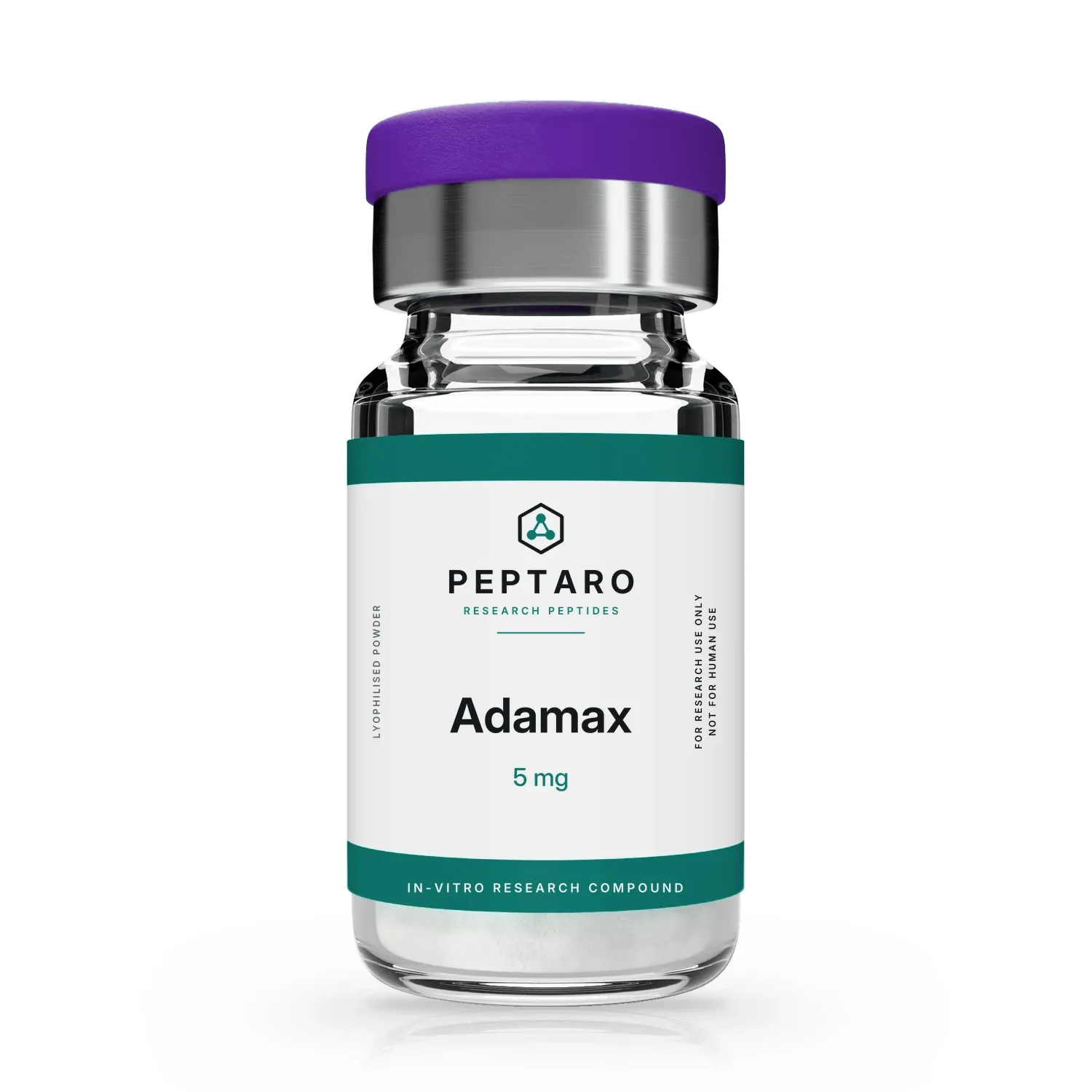
Adamax
5mg
In Stock · Ready to Ship£39.99£8.00/mg
98.8% RP-HPLCJanoshikBatch UKPL-9513
£27.99£2.80/mg
In Stock · Ready to Ship
Minimum order £299.00 per basket: mix any products. Research kits meet it on their own.
Dispatched same day if ordered by 3pm (Mon–Fri) · Royal Mail Tracked 24
| Vials in basket | Per vial | Saving |
|---|---|---|
| 1–2 | £27.99 | — |
| 3+ | £26.59 | 5% |
| 5+ | £25.75 | 8% |
| 10+ | £24.63 | 12% |
Discounts are basket-wide: mix any vials.
Documentation for each item ships with your order.
For in-vitro laboratory research use only. Not for human or veterinary use.
Documentation for each item ships with your order. The batch number printed on your vial matches it.
Delta sleep-inducing peptide (DSIP) is a nonapeptide (Trp-Ala-Gly-Gly-Asp-Ala-Ser-Gly-Glu) first isolated from rabbit cerebral venous blood. Research has examined its reported effects on sleep architecture, stress hormone regulation and circadian rhythms, with human evidence remaining limited. This 10mg presentation is the higher-mass research format of our 5mg vial. Supplied as lyophilised powder, supplier-tested, with the certificate published on this page and independent third-party verification pending.
Delta sleep-inducing peptide (DSIP) is a nonapeptide (Trp-Ala-Gly-Gly-Asp-Ala-Ser-Gly-Glu) first isolated from rabbit cerebral venous blood. Research has examined its reported effects on sleep architecture, stress hormone regulation and circadian rhythms, with human evidence remaining limited. This 10mg presentation is the higher-mass research format of our 5mg vial.
DSIP 10mg holds the same delta sleep-inducing peptide as our 5mg vial, at twice the mass. It is a nonapeptide, Trp-Ala-Gly-Gly-Asp-Ala-Ser-Gly-Glu, with a free acid C-terminus, a molecular weight of 848.8 g/mol and CAS number 62568-57-4. Its international nonproprietary name is emideltide. Schoenenberger and Monnier isolated it from rabbit cerebral venous blood (Proc Natl Acad Sci U S A, 1977). They named it for the delta-wave EEG activity its intraventricular infusion appeared to produce in recipient animals.
Much of its biology is still open. No receptor has been identified, no gene encoding it has been isolated, and whether it occurs naturally is disputed. Kovalzon and Strekalova (J Neurochem, 2006) called it a still unresolved riddle.
The primary literature is old, uneven and in places contradictory. DSIP is best treated as a compound for hypothesis testing and replication, not a tool with a known mechanism.
Both vials hold the identical compound, with the same sequence, CAS number and lyophilised form. The difference is logistics. The 5mg vial suits pilot work and single assays. The 10mg vial puts twice the mass in one container, so a long series needs fewer vials and fewer reconstitutions, and vial-to-vial variation matters less. That headroom suits replication work, which the uneven DSIP literature needs.
Delta sleep-inducing peptide (DSIP) is a nonapeptide first isolated from rabbit cerebral venous blood, and it is the compound behind Peptaro's DSIP 10mg vial. The sequence is Trp-Ala-Gly-Gly-Asp-Ala-Ser-Gly-Glu, an unusually acidic nine-residue peptide with a molecular weight of 848.8 g/mol, molecular formula C₃₅H₄₈N₁₀O₁₅ and CAS number 62568-57-4. It was isolated by the Schoenenberger and Monnier group in Basel and reported in 1977, when the team showed that material recovered from rabbits during electrically induced slow-wave sleep enhanced delta and spindle electroencephalogram activity after intraventricular infusion (Schoenenberger and Monnier, Proc Natl Acad Sci U S A, 1977). This 10mg presentation is the higher-mass research format of our 5mg vial: the same compound, supplied at twice the peptide mass per vial, for laboratories running extended assay series.
Research has examined DSIP across three main strands: sleep architecture, stress hormone regulation and circadian rhythms. The earliest sleep work reported enhanced delta-wave sleep in several species, and Graf and Kastin's review of the field (Neurosci Biobehav Rev, 1984) catalogued those early reports alongside effects on circadian and locomotor patterns and on circulating hormone levels. On the neuroendocrine side, in-vitro work reported that DSIP inhibited corticotropin-releasing factor-induced ACTH secretion from rat anterior pituitary tissue, placing it in the hypothalamic-pituitary-adrenal literature (Okajima and Hertting, Horm Metab Res, 1986).
The honest caveat belongs up front, because DSIP is a compound whose name promises more than the literature delivers. No specific DSIP receptor has ever been identified, no gene encoding the peptide has been found in any sequenced genome, and the original sleep-induction findings have proved difficult to replicate consistently; Kovalzon and Strekalova summarised the field in the Journal of Neurochemistry in 2006 under the title 'a still unresolved riddle'. Human evidence remains limited. Early human studies reported effects on disturbed sleep (Schneider-Helmert and Schoenenberger, Neuropsychobiology, 1983), but a double-blind matched-pairs study in 16 chronic insomniac patients found weak, partly confounded effects and concluded that short-term treatment was unlikely to offer major therapeutic benefit (Bes et al., Neuropsychobiology, 1992).
DSIP is not an approved medicine in any jurisdiction and is supplied as lyophilised powder for in-vitro laboratory research use only, with no dosing information and no human-use claims. The 10mg vial is supplier-tested, with the certificate published on this page, and independent third-party verification is pending.
Move vials to the freezer on arrival and keep them dark and dry. Keep the solution in a light-protected container. Aliquot at reconstitution: thawing a whole 10mg stock again and again degrades the tryptophan in everything left. Tryptophan oxidation shows up as a new RP-HPLC peak after long or light-exposed storage.
Vials are sold on their own, without bacteriostatic water for mixing or other supplies.
How to reconstitute and handle
For the full method, see the peptide reconstitution guide and the reconstitution calculator.
Published research on DSIP is indexed on PubMed. See our full UK buyer's guide for DSIP 10mg.
| CAS number | 62568-57-4 |
|---|---|
| Molecular formula | C₃₅H₄₈N₁₀O₁₅ |
| Molecular weight | 848.8 g/mol |
| Sequence | Trp-Ala-Gly-Gly-Asp-Ala-Ser-Gly-Glu |
| Form | Lyophilised powder |
| Appearance | White lyophilised powder |
| Release specification | ≥98.0% |
| Storage | -20°C lyophilised, 2-8°C reconstituted |
Store sealed lyophilised vials at −20 °C, protected from light and moisture. For preparation, aliquoting and storage of reconstituted stock, see the laboratory reconstitution guide and the concentration calculator.
The compound is identical: the same nonapeptide, the same CAS number and the same lyophilised form. The difference is the presentation. The 10mg vial contains twice the peptide mass of the 5mg vial, which means fewer vials, fewer reconstitution events and less vial-to-vial variability across a long series of assays. The 5mg vial remains available for pilot work and single experiments.
The original 1977 work reported that DSIP enhanced delta and spindle EEG activity after intraventricular infusion in rabbits, and early human studies reported effects on disturbed sleep (Schneider-Helmert and Schoenenberger, Neuropsychobiology, 1983). However, a double-blind study in 16 chronic insomniac patients found effects that were weak and partly confounded, concluding that short-term treatment was unlikely to offer major therapeutic benefit (Bes et al., Neuropsychobiology, 1992). Replication across the literature has been inconsistent, and no receptor or mechanism has ever been established.
DSIP has been examined for stress hormone regulation, with in-vitro work reporting inhibition of corticotropin-releasing factor-induced ACTH secretion from rat anterior pituitary tissue (Okajima and Hertting, Horm Metab Res, 1986), and for circadian rhythms, with effects on circadian and locomotor patterns catalogued by Graf and Kastin (Neurosci Biobehav Rev, 1984). A further strand uses LC-MS methods to test whether the peptide exists endogenously at all (Kovalzon and Strekalova, J Neurochem, 2006).
The current batch (UKPL-9513) is supplier-tested at 98.80% purity by HPLC, with the supplier certificate of analysis published on this page. Independent third-party verification is pending, and the independent certificate will be published here once complete.
Peptaro sells DSIP 10mg vials from UK stock, alongside the 5mg vial. Orders placed before 3pm on a working day are dispatched the same day by Royal Mail Tracked, and tracked UK delivery is free on every order. It is sold for in-vitro research only, to buyers aged 18 or over.
Not yet. The certificate for batch UKPL-9513 is the supplier's analysis: 98.80% purity by HPLC and 10.02mg measured content. Independent third-party testing is pending, and that certificate will be published when complete. The 5mg DSIP vial is a separate batch with its own certificate.
Preclinical sleep, stress-hormone and circadian research. Studies look at delta-wave sleep architecture in rodents, ACTH regulation in pituitary tissue and locomotor rhythms. The 10mg vial suits longer assay series than the 5mg format.
No. Peptaro supplies DSIP 10mg strictly for in-vitro laboratory research. It is not a medicine and is not for human or veterinary use, and we don't give usage advice.
-20°C lyophilised, 2-8°C reconstituted. For preparing and aliquoting stock solutions, see the laboratory reconstitution guide.
Orders placed by 3pm Monday to Friday (excluding bank holidays) are dispatched the same working day by Royal Mail Tracked 24. Delivery is free, tracked and cold-packed. The minimum order is £299.
5mg
In Stock · Ready to Ship
10mg
In Stock · Ready to Ship
5mg · 10mg
In Stock · Ready to Ship
10+10mg
In Stock · Ready to ShipResearch use only. For in-vitro laboratory research use only. Not for human or veterinary use. By continuing you confirm you are 18+ and purchasing for laboratory research.