Adamax
5mg
In Stock · Ready to Ship£39.99£8.00/mg
£34.99£1.75/mg
In Stock · Ready to Ship
Minimum order £299.00 per basket: mix any products. Research kits meet it on their own.
Dispatched same day if ordered by 3pm (Mon–Fri) · Royal Mail Tracked 24
| Vials in basket | Per vial | Saving |
|---|---|---|
| 1–2 | £34.99 | — |
| 3+ | £33.24 | 5% |
| 5+ | £32.19 | 8% |
| 10+ | £30.79 | 12% |
Discounts are basket-wide: mix any vials.
Documentation for each item ships with your order.
For in-vitro laboratory research use only. Not for human or veterinary use.
Documentation for each item ships with your order. The batch number printed on your vial matches it.
This blend pairs Selank (Thr-Lys-Pro-Arg-Pro-Gly-Pro), a synthetic analogue of the tuftsin peptide, with Semax (Met-Glu-His-Phe-Pro-Gly-Pro), a synthetic analogue of ACTH(4-10), in a 10+10mg presentation. Both are Russian-developed nootropic peptides studied for anxiolytic and cognitive effects in animal and early human research. Supplied as lyophilised powder, supplier-tested, with the certificate published on this page and independent third-party verification pending.
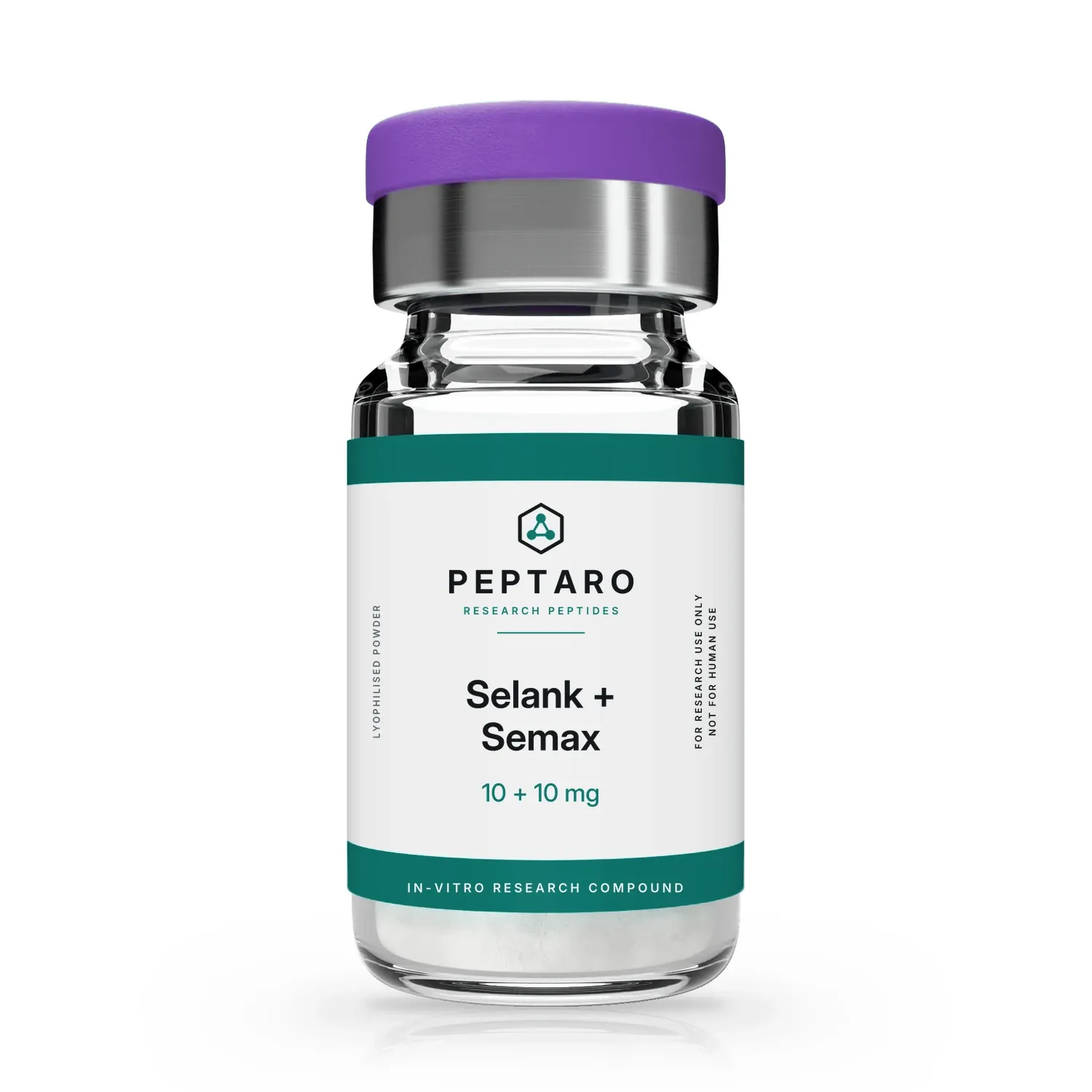
Selank + Semax 10+10mg is a pre-blended vial of two Russian-developed heptapeptides, 10mg of each, as lyophilised powder. Selank is Thr-Lys-Pro-Arg-Pro-Gly-Pro, an analogue of tuftsin. Semax is Met-Glu-His-Phe-Pro-Gly-Pro, an analogue of ACTH(4-10).
Both peptides come from the Institute of Molecular Genetics of the Russian Academy of Sciences and share one design. A short active fragment carries a C-terminal Pro-Gly-Pro tail that slows enzymatic breakdown. Both are registered medicines in Russia and hold no MHRA, EMA or FDA authorisation.
The two molecular weights are close, 751.9 and 813.9 g/mol, so this equal-mass blend is nearly equimolar: about 13.3 µmol of Selank to 12.3 µmol of Semax. The blend itself has no dedicated literature.
The blend suits preclinical designs that would otherwise run both peptides from separate preparations, such as GABAergic and neurotrophin endpoints measured in one rodent cohort, or enzyme-inhibition assays. Its practical value is one reconstitution and one in-use window.
Each peptide has its own evidence base. Selank work centres on enkephalin-degrading enzymes and GABAergic gene expression. Semax work centres on BDNF and trkB signalling and ischaemia models. One study measured both side by side (Kost et al., Bioorg Khim, 2001). In human serum, Semax inhibited enkephalin-degrading enzymes with an IC50 of 10 µM and Selank with 20 µM. No controlled study has tested the co-formulated mixture. Once dissolved the ratio is fixed, so designs needing independent concentrations, a single-peptide control or attribution to one mechanism need the separate vials.
This is the pre-blended presentation, a single lyophilised vial containing Selank 10mg and Semax 10mg. The blend pairs two Russian-developed nootropic heptapeptides: Selank, a synthetic analogue of the immunoglobulin-derived tetrapeptide tuftsin (Thr-Lys-Pro-Arg-Pro-Gly-Pro, 751.9 g/mol, CAS 129954-34-3), and Semax, a synthetic analogue of the ACTH(4-10) fragment (Met-Glu-His-Phe-Pro-Gly-Pro, 813.7 g/mol, CAS 80714-61-0). Both have been studied for anxiolytic and cognitive effects in animal models and early human research, with the Selank literature weighted towards anxiety-related mechanisms and the Semax literature towards neurotrophin biology and neuroprotection.\n\nBoth compounds share a design origin, the Institute of Molecular Genetics of the Russian Academy of Sciences, and one stabilisation strategy: a C-terminal Pro-Gly-Pro extension protecting a short active fragment from rapid enzymatic degradation. That shared chemistry is why they are so often studied side by side, and why a co-formulated vial is a natural format for designs running both. What the blend as a format gives is procedural: one vial means one reconstitution, one fill volume, one solution and one in-use window, removing a transfer step along with its sterility and volumetric error. What it removes is independent control. The two components cannot be separated after reconstitution, and an equal-mass blend is not automatically equimolar, though the arithmetic here is unusually forgiving. The two molecular weights differ by only 62 g/mol, so 10mg of each corresponds to roughly 13.3 µmol of Selank against 12.3 µmol of Semax, close to a true 1:1 molar ratio.\n\nThe honest position on the pairing is that no controlled study has evaluated this specific combination, and the blend should be treated as two separate compounds in one container. Each component carries its own literature: Selank has been reported to inhibit enkephalin-degrading enzymes (Zozulya et al., Bull Exp Biol Med, 2001) and to alter the expression of GABAergic neurotransmission genes in rat brain (Volkova et al., Front Pharmacol, 2016), while Semax has been reported to upregulate hippocampal BDNF and trkB (Dolotov et al., Brain Res, 2006) and to reduce infarct volume in a rat model of focal cerebral ischaemia (Romanova et al., Bull Exp Biol Med, 2006). The primary literature for both compounds is largely Russian in origin and lacks extensive independent Western replication, and neither compound holds a marketing authorisation from the MHRA, EMA or FDA. In-vitro laboratory research use only.
Keep sealed vials at -20°C, away from light and moisture. After reconstitution, keep the solution at 2-8°C and use it within 4 weeks, or freeze single-use aliquots at -20°C. Both peptides share one reconstitution date, so aliquot at the start and avoid repeated freeze-thaw cycles.
Vials are sold on their own, without bacteriostatic water for mixing or other supplies.
How to reconstitute and handle
Treat the vial as one 20mg preparation, with the fill volume set by the concentration your protocol needs. Let the vial and the bacteriostatic water reach room temperature and swab both stoppers. Add the water slowly down the inside wall and swirl gently until dissolved. Do not shake or vortex. The solution should be clear and colourless. The N-terminal methionine of Semax oxidises in air and light, so keep stopper-open time short. Label the vial with fill volume, concentration and date.
For the full method, see the peptide reconstitution guide and the reconstitution calculator.
Published research on Selank + Semax is indexed on PubMed. See our full UK buyer's guide for Selank + Semax Blend.
| CAS number | 129954-34-3 / 80714-61-0 |
|---|---|
| Molecular weight | 751.9 / 813.7 g/mol |
| Form | Lyophilised powder (co-formulated) |
| Appearance | White lyophilised powder (single vial) |
| Storage | -20°C lyophilised, 2-8°C reconstituted |
Store sealed lyophilised vials at −20 °C, protected from light and moisture. For preparation, aliquoting and storage of reconstituted stock, see the laboratory reconstitution guide and the concentration calculator.
One vial containing 10mg of Selank and 10mg of Semax, 20mg of peptide in total, lyophilised together. Selank is the tuftsin analogue Thr-Lys-Pro-Arg-Pro-Gly-Pro (751.9 g/mol, CAS 129954-34-3) and Semax is the ACTH(4-10) analogue Met-Glu-His-Phe-Pro-Gly-Pro (813.7 g/mol, CAS 80714-61-0). Batch UKPL-9517 is supplier-tested with per-component content verified and the certificate published on this page, and independent third-party verification is pending.
It is 1:1 by mass and very close to 1:1 by moles. The two molecular weights differ by only 62 g/mol, so 10mg of each corresponds to roughly 13.3 µmol of Selank against 12.3 µmol of Semax, a molar ratio near 1.08 to 1. For this pairing the mass and molar descriptions are nearly interchangeable, which is unusual among equal-mass peptide blends.
Because they are the two flagship compounds of one design programme. Both carry the same C-terminal Pro-Gly-Pro stabilising tail protecting a short active fragment, tuftsin in Selank and the ACTH(4-10) core in Semax, and their reported endpoints are largely complementary: anxiety-related mechanisms for Selank, neurotrophin and neuroprotection endpoints for Semax. The shared tail makes them natural controls for one another's stabilisation chemistry.
No. No controlled study has evaluated these two compounds co-administered at this ratio, and no synergy between them has been demonstrated. Every mechanistic finding cited for the pairing comes from work on one component in isolation. Researchers should treat the blend as two separate compounds in one container and design controls accordingly, rather than assuming combined behaviour that has not been tested.
Peptaro supplies a pre-blended Selank + Semax 10+10mg vial in the UK, batch UKPL-9517, supplier-tested with per-component content verified, with the certificate of analysis published on this page and independent third-party verification pending. Same-day dispatch on orders placed before 3pm UK time, free tracked UK delivery on every order. Individual 10mg vials of each compound are also stocked. Research use only, purchasers must be 18 or over.
Peptaro has the Selank + Semax 10+10mg blend for sale from UK stock, batch UKPL-9517. Orders placed before 3pm UK time on a working day are dispatched the same day, and tracked UK delivery is free on every order.
Not yet. The certificate for batch UKPL-9517 is a supplier-reported analysis, published on the product page. It reports each peptide separately: 9.98mg Selank and 10.20mg Semax. Independent third-party verification is pending.
Buy the blend for combined designs at a fixed 1:1 mass ratio, from one vial and one reconstitution. Buy the individual 10mg vials to vary the ratio, run a single-peptide control or attribute an effect to one molecule. Both formats are stocked, each with its own batch.
No. Peptaro supplies Selank + Semax 10+10mg strictly for in-vitro laboratory research. It is not a medicine and is not for human or veterinary use, and we don't give usage advice.
-20°C lyophilised, 2-8°C reconstituted. For preparing and aliquoting stock solutions, see the laboratory reconstitution guide.
Orders placed by 3pm Monday to Friday (excluding bank holidays) are dispatched the same working day by Royal Mail Tracked 24. Delivery is free, tracked and cold-packed. The minimum order is £299.
Research use only. For in-vitro laboratory research use only. Not for human or veterinary use. By continuing you confirm you are 18+ and purchasing for laboratory research.