BPC-157
5mg · 10mg
In Stock · Ready to Shipfrom £16.95from £2.90/mg
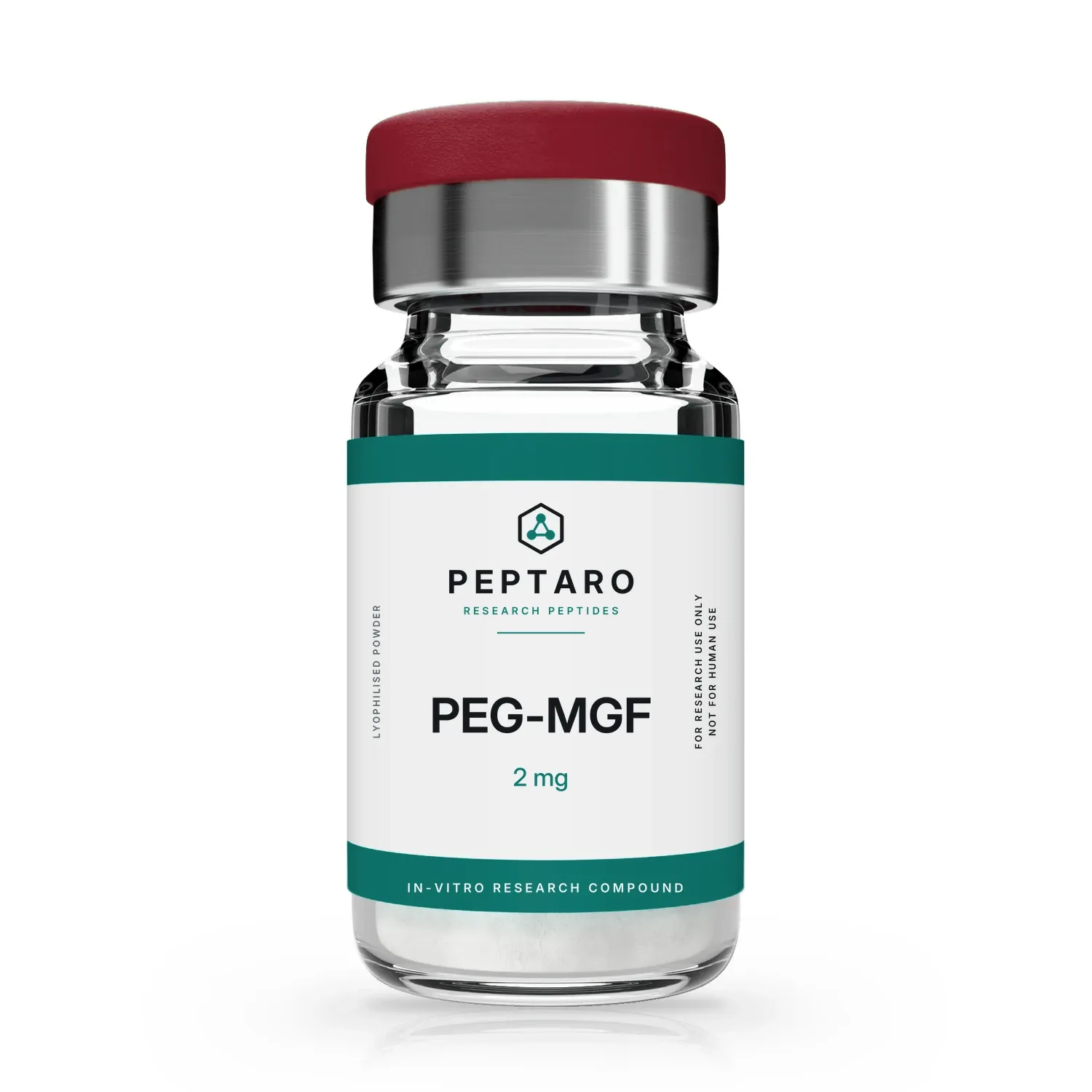
99.77% RP-HPLCJanoshikBatch UKPL-9506
£19.99£9.99/mg
In Stock · Ready to Ship
Minimum order £299.00 per basket: mix any products. Research kits meet it on their own.
Dispatched same day if ordered by 3pm (Mon–Fri) · Royal Mail Tracked 24
| Vials in basket | Per vial | Saving |
|---|---|---|
| 1–2 | £19.99 | — |
| 3+ | £18.99 | 5% |
| 5+ | £18.39 | 8% |
| 10+ | £17.59 | 12% |
Discounts are basket-wide: mix any vials.
Documentation for each item ships with your order.
For in-vitro laboratory research use only. Not for human or veterinary use.
Documentation for each item ships with your order. The batch number printed on your vial matches it.
PEG-MGF is a PEGylated form of mechano growth factor, the IGF-1Ec splice-variant peptide expressed in muscle tissue in response to mechanical load. PEGylation of the 24-residue sequence slows clearance relative to the unmodified peptide, and research has examined both forms in models of muscle cell proliferation and satellite cell activation. Supplied as lyophilised powder, supplier-tested, with the certificate published on this page and independent third-party verification pending.
PEG-MGF is a PEGylated form of mechano growth factor, the IGF-1Ec splice-variant peptide expressed in muscle tissue in response to mechanical load. PEGylation of the 24-residue sequence slows clearance relative to the unmodified peptide, and research has examined both forms in models of muscle cell proliferation and satellite cell activation.
The peptide is the 24-residue E domain of the IGF-1Ec splice variant: Tyr-Gln-Pro-Pro-Ser-Thr-Asn-Lys-Asn-Thr-Lys-Ser-Gln-Arg-Arg-Lys-Gly-Ser-Thr-Phe-Glu-Glu-His-Lys (YQPPSTNKNTKSQRRKGSTFEEHK). The batch certificate lists the conjugate at roughly 9.8 kDa. As a polymer conjugate it has no CAS number. Yang, Alnaqeeb, Simpson and Goldspink (J Muscle Res Cell Motil, 1996) cloned the splice variant from stretched rabbit muscle.
In the literature, MGF can mean the splice-variant mRNA or the synthetic E-domain peptide (Matheny, Nindl and Adamo, Endocrinology, 2010). PEG-MGF, also written pegylated MGF, is the E-domain peptide with a PEG chain attached. Each vial holds 2mg of white lyophilised powder.
All of these studies used the unmodified E peptide. No peer-reviewed paper has tested the PEGylated form, so its behaviour in an assay is an extrapolation. Other published models use progenitor cells from normal, dystrophic and ALS muscle (Ates et al., FEBS Lett, 2007). Mills and colleagues (Am J Transplant, 2007) studied engraftment of human myogenic precursor cells in mice. There are no clinical trials.
Both contain the same 24-residue E-domain peptide. MGF is the unmodified peptide, the molecule used in every published study cited here. PEG-MGF adds polyethylene glycol, which raises the mass to roughly 9.8 kDa. The polymer also changes how the conjugate behaves in the lab. It runs at a higher apparent mass on size-exclusion columns and can interfere with antibody-based detection. MGF is the choice for replicating published work. With PEG-MGF, count the PEG chain as an extra variable to control.
PEG-MGF is the PEGylated form of mechano growth factor (MGF), the 24-residue C-terminal E-domain peptide of the IGF-1Ec splice variant of insulin-like growth factor 1. The underlying peptide sequence is Tyr-Gln-Pro-Pro-Ser-Thr-Asn-Lys-Asn-Thr-Lys-Ser-Gln-Arg-Arg-Lys-Gly-Ser-Thr-Phe-Glu-Glu-His-Lys, written YQPPSTNKNTKSQRRKGSTFEEHK, with a molecular weight of approximately 2866 g/mol unmodified and approximately 9.8 kDa in the PEGylated form supplied here. The splice variant was first cloned from mechanically stretched rabbit muscle by Yang, Alnaqeeb, Simpson and Goldspink (J Muscle Res Cell Motil, 1996), and its expression in muscle in response to mechanical load is what the mechano growth factor name records. PEG-MGF is a conjugate rather than a discrete small molecule and carries no CAS registry number on this listing.
The splice biology matters because it defines what the molecule is. The IGF-1Ec transcript carries a 49-base insert in the human sequence, and because the insert is not a multiple of three, the reading frame shifts and the C-terminal E domain is encoded in a different frame from the systemic IGF-1Ea isoform. It is that E-domain peptide, rather than the mature IGF-1 protein, that the early literature connected to muscle repair: the peptide drives myoblast proliferation while blocking differentiation (Yang and Goldspink, FEBS Lett, 2002), appears as an early pulse after local muscle damage in association with satellite cell activation (Hill and Goldspink, J Physiol, 2003), and increased progenitor cell numbers in cultures from normal, dystrophic and ALS muscle (Ates et al., FEBS Lett, 2007). Goldspink's review (Physiology, 2005) frames MGF as the local, damage-triggered isoform, with splicing switching toward IGF-1Ea as repair proceeds.
The PEGylation step is a pharmacokinetic modification, not a change to the peptide chemistry. The unmodified E peptide is cleared from circulation within minutes, so conjugation of polyethylene glycol, raising the mass to roughly 9.8 kDa, is designed to slow clearance through increased hydrodynamic radius, reduced renal filtration and shielding from proteases, the standard logic of the field reviewed by Harris and Chess (Nat Rev Drug Discov, 2003). In primary human muscle cell culture, the unmodified E peptide increased proliferation and delayed senescence in cultures from neonatal and young adult donors but not old adult muscle (Kandalla et al., Mech Ageing Dev, 2011), and in a mouse transplantation model it improved myogenic precursor cell engraftment (Mills et al., Am J Transplant, 2007).
It is worth being direct about the state of the evidence. The primary literature concerns the unmodified E-domain peptide, and the PEGylated form itself has no dedicated peer-reviewed publications, so its behaviour in any assay is an extrapolation from the unmodified molecule and from general PEGylation pharmacology. The founding in-vitro claims have also been challenged directly: a study conducted at two pharmaceutical companies found no effect of the MGF C-terminal peptide, at concentrations up to 500 ng/ml, on the proliferation or differentiation of C2C12 cells, primary human myoblasts or primary mouse muscle stem cells, and concluded that the physiological role of MGF itself should be questioned (Fornaro et al., Am J Physiol Endocrinol Metab, 2014). Human evidence is thin to absent, and the field's own review literature describes MGF as a putative repair factor (Matheny, Nindl and Adamo, Endocrinology, 2010). PEG-MGF is not an approved medicine in any jurisdiction and is supplied as lyophilised powder, supplier-tested at 99.77% purity with batch UKPL-9506, with the certificate published on this page and independent third-party verification pending, for in-vitro laboratory research only.
Move vials to the freezer on arrival and keep them dark and dry. Freeze reconstituted stock in single-use aliquots and thaw each one once. PEG conjugates still aggregate under repeated freeze-thaw. Keep the solution away from oxidising agents and organic solvents.
Vials are sold on their own, without bacteriostatic water for mixing or other supplies.
How to reconstitute and handle
For the full method, see the peptide reconstitution guide and the reconstitution calculator.
Published research on PEG-MGF is indexed on PubMed. See our full UK buyer's guide for PEG-MGF.
| Molecular weight | ~9.8 kDa PEGylated (unmodified peptide ~2866 g/mol) |
|---|---|
| Sequence | YQPPSTNKNTKSQRRKGSTFEEHK (24-residue IGF-1Ec E domain) |
| Form | Lyophilised powder |
| Appearance | White lyophilised powder |
| Release specification | ≥98.0% |
| Storage | -20°C lyophilised, 2-8°C reconstituted |
Store sealed lyophilised vials at −20 °C, protected from light and moisture. For preparation, aliquoting and storage of reconstituted stock, see the laboratory reconstitution guide and the concentration calculator.
Both contain the same 24-residue E-domain peptide, YQPPSTNKNTKSQRRKGSTFEEHK. MGF is the unmodified peptide at approximately 2866 g/mol, and it is the molecule that appears in the primary literature. PEG-MGF is the same sequence with polyethylene glycol conjugated to it, raising the mass to roughly 9.8 kDa. PEGylation slows clearance by increasing hydrodynamic radius, reducing renal filtration and slowing proteolysis (Harris and Chess, Nat Rev Drug Discov, 2003), but the PEGylated form itself has no dedicated peer-reviewed publications.
The unmodified MGF E-domain peptide is cleared from circulation within minutes, which limits most published work to cell culture or local delivery. Conjugation of polyethylene glycol increases the molecule's hydrodynamic radius, reduces renal filtration and shields it from proteolytic degradation, the general strategy reviewed by Harris and Chess (Nat Rev Drug Discov, 2003). It is a pharmacokinetic modification; the peptide sequence is unchanged.
The underlying 24-residue sequence is Tyr-Gln-Pro-Pro-Ser-Thr-Asn-Lys-Asn-Thr-Lys-Ser-Gln-Arg-Arg-Lys-Gly-Ser-Thr-Phe-Glu-Glu-His-Lys, written YQPPSTNKNTKSQRRKGSTFEEHK, approximately 2866 g/mol unmodified. The PEGylated conjugate supplied here runs at roughly 9.8 kDa. PEG-MGF is a conjugate rather than a discrete small molecule and carries no CAS registry number on this listing. Supplied for in-vitro laboratory research only.
Peptaro sells PEG-MGF 2mg vials from UK stock. Orders placed before 3pm on a working day are dispatched the same day by Royal Mail Tracked, and tracked UK delivery is free on every order. It is sold for in-vitro research only, to buyers aged 18 or over.
Yes. The supplier's analysis of batch UKPL-9506 reports 99.77% purity by RP-HPLC and 2.02mg measured content against the 2mg label. Independent third-party testing is pending. The certificate is published with this listing, and its batch number matches the one printed on the vial.
It is bought for muscle-cell research on the IGF-1Ec splice variant: myoblast proliferation, satellite cell activation and myogenic precursor engraftment. The published studies behind those models used unmodified MGF (Yang and Goldspink, 2002; Hill and Goldspink, 2003; Mills et al., 2007). The PEGylated form has no dedicated peer-reviewed literature.
It attaches a polyethylene glycol chain to the 24-residue peptide, which the certificate lists by sequence. PEGylation raises molecular mass, and in drug development it is used to reduce renal clearance and protease breakdown (Harris and Chess, Nat Rev Drug Discov, 2003). In the lab it also shifts apparent mass on columns and gels.
No. Peptaro supplies PEG-MGF 2mg strictly for in-vitro laboratory research. It is not a medicine and is not for human or veterinary use, and we don't give usage advice.
-20°C lyophilised, 2-8°C reconstituted. For preparing and aliquoting stock solutions, see the laboratory reconstitution guide.
Orders placed by 3pm Monday to Friday (excluding bank holidays) are dispatched the same working day by Royal Mail Tracked 24. Delivery is free, tracked and cold-packed. The minimum order is £299.
5mg · 10mg
In Stock · Ready to Ship
5+5mg · 10+10mg
In Stock · Ready to Ship
5+5mg · 10+10mg
In Stock · Ready to Ship
50mg · 100mg
In Stock · Ready to ShipResearch use only. For in-vitro laboratory research use only. Not for human or veterinary use. By continuing you confirm you are 18+ and purchasing for laboratory research.