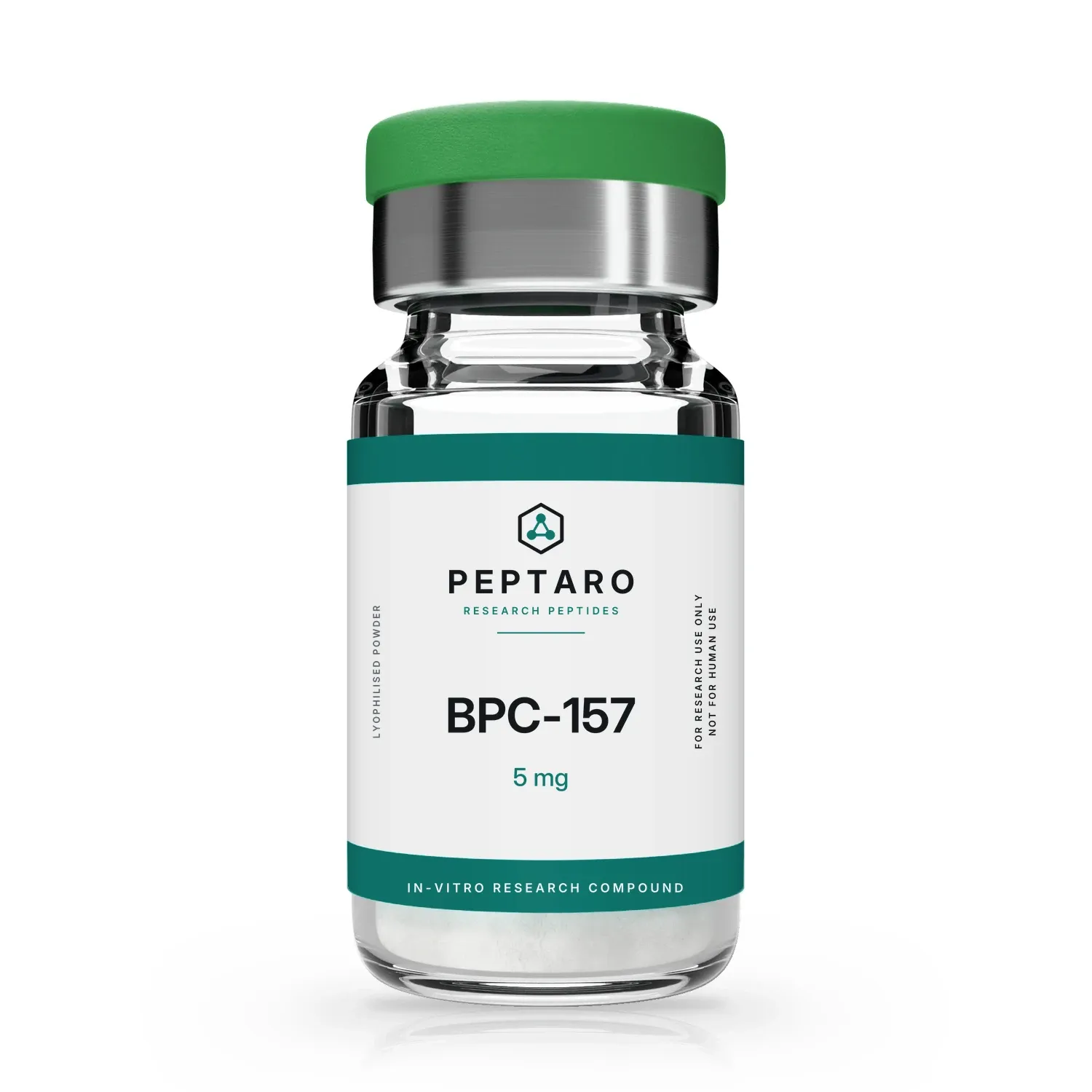
BPC-157
5mg · 10mg
In Stock · Ready to Shipfrom £16.95from £2.90/mg
£54.99£2.75/mg
In Stock · Ready to Ship
Minimum order £299.00 per basket: mix any products. Research kits meet it on their own.
Dispatched same day if ordered by 3pm (Mon–Fri) · Royal Mail Tracked 24
| Vials in basket | Per vial | Saving |
|---|---|---|
| 1–2 | £54.99 | — |
| 3+ | £52.24 | 5% |
| 5+ | £50.59 | 8% |
| 10+ | £48.39 | 12% |
Discounts are basket-wide: mix any vials.
Documentation for each item ships with your order.
For in-vitro laboratory research use only. Not for human or veterinary use.
Documentation for each item ships with your order. The batch number printed on your vial matches it.
This blend pairs BPC-157 (Gly-Glu-Pro-Pro-Pro-Gly-Lys-Pro-Ala-Asp-Asp-Ala-Gly-Leu-Val) with TB-500, the synthetic 17-23 fragment of thymosin beta-4 (Ac-Leu-Lys-Lys-Thr-Glu-Thr-Gln), in a 10+10mg presentation. Both are among the most referenced peptides in cell migration, angiogenesis and tissue repair research. Supplied as lyophilised powder, third-party tested by Janoshik Analytical for per-component content, with the certificate published on this page.
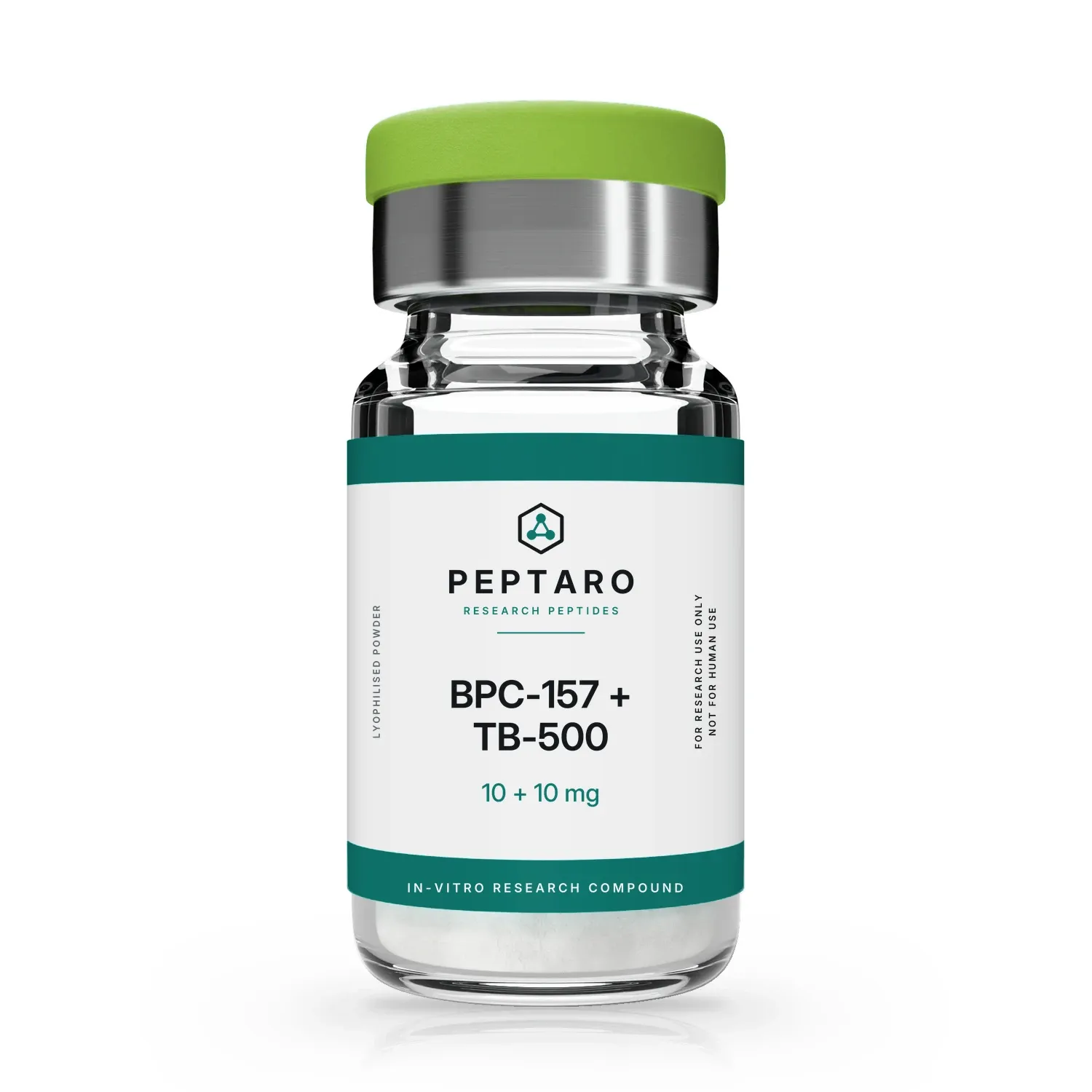
BPC-157 + TB-500 10+10mg is the larger pre-blended vial: 10mg of each peptide, 20mg in total, as lyophilised powder under batch UKPL-9514. The chemistry and the mass ratio match the 5+5mg vial.
BPC-157 is the 15-residue peptide GEPPPGKPADDAGLV at 1419.53 g/mol. TB-500 is listed with the identifiers of thymosin beta 4: CAS 77591-33-4 and 4963.4 g/mol. Their mechanisms and literature are covered on the single BPC-157 and TB-500 pages. Doubling both masses leaves the molar ratio unchanged. No controlled study has tested this combination.
The 10+10mg vial suits preclinical soft-tissue and cell-migration designs that use more peptide than a 5+5mg vial supplies. Examples are long explant or co-culture experiments, concentration-response matrices, and studies that must hold one batch across every arm.
Nothing chemical changes between the two sizes. Both are equal by mass and about 3.5 to 1 by moles in favour of BPC-157. What changes is procedure. The 10+10mg vial gives twice the peptide per reconstitution, so a study needing a given total mass uses half the vials and crosses one batch boundary instead of two. It supports double the concentration at a fixed fill volume, or double the volume at a fixed concentration. The cost is that 20mg shares one in-use window, which wastes material in slow, low-throughput designs.
BPC-157 + TB-500 10+10mg is a co-formulated research vial holding 10mg of each peptide, 20mg of total peptide, supplied as lyophilised powder. BPC-157 is the pentadecapeptide Gly-Glu-Pro-Pro-Pro-Gly-Lys-Pro-Ala-Asp-Asp-Ala-Gly-Leu-Val, CAS 137525-51-0, molecular weight 1419.53 g/mol. TB-500 is the synthetic 17-23 fragment of thymosin beta-4, Ac-Leu-Lys-Lys-Thr-Glu-Thr-Gln, CAS 77591-33-4, molecular weight 4963.4 g/mol. Both compounds sit among the most referenced peptides in cell migration, angiogenesis and tissue repair research, and their individual literatures are covered in full on the separate BPC-157 and TB-500 product pages.
The two components report through distinct mechanisms. For BPC-157, Hsieh and colleagues (J Mol Med, 2017) reported upregulation and internalisation of VEGFR2 in human endothelial cells, and Chang and colleagues (J Appl Physiol, 2011) reported increased phosphorylation of focal adhesion kinase and paxillin in cultured rat tendon fibroblasts. For thymosin beta-4, Bock-Marquette and colleagues (Nature, 2004) reported cell migration and survival effects in mouse cardiac injury models, and Philp and colleagues (Wound Repair Regen, 2003) found the synthetic actin-binding domain peptide LKKTETQ promoted dermal wound repair in diabetic and aged mice.
This is the higher-mass presentation of the blend also offered at 5+5mg, and the chemistry is identical; what changes is quantity. Doubling the mass doubles the molar amounts without altering the ratio: 10mg of BPC-157 is roughly 7.0 µmol and 10mg of TB-500 roughly 2.0 µmol, an approximate 3.5 to 1 molar ratio in favour of BPC-157, exactly as in the 5+5mg rung. The 10+10mg vial means fewer vials, fewer reconstitution events and fewer lot boundaries for a given total mass, at the cost of placing 20mg behind a single in-use window.
No controlled study has evaluated this specific combination, so combination-specific claims cannot be supported, and a 2025 review by McGuire and colleagues (Curr Rev Musculoskelet Med) found no adequately powered randomised controlled trials for BPC-157 in musculoskeletal healing. It is not a licensed medicine and is not for human consumption.
Keep sealed vials at -20°C, away from light and moisture. After reconstitution, keep the solution at 2-8°C and use it within 4 weeks, or freeze single-use aliquots at -20°C. With 20mg behind one reconstitution date, aliquot early and avoid repeated freeze-thaw cycles.
Vials are sold on their own, without bacteriostatic water for mixing or other supplies.
How to reconstitute and handle
Treat the vial as one 20mg preparation, with the fill volume set by the concentration your protocol needs. Let the vial and the bacteriostatic water reach room temperature and swab both stoppers. Add the water slowly down the inside wall and swirl gently. Do not shake or vortex. The larger cake can take a little longer to dissolve, so wait for a fully clear, colourless solution. The peptides cannot be separated afterwards. Label the vial with fill volume, concentration and date.
For the full method, see the peptide reconstitution guide and the reconstitution calculator.
Published research on BPC-157 + TB-500 is indexed on PubMed. See our full UK buyer's guide for Wolverine Stack and UK buyer's guide for BPC-157 + TB-500 10+10mg.
| CAS number | 137525-51-0 / 77591-33-4 |
|---|---|
| Molecular weight | 1419.53 / 4963.4 g/mol |
| Form | Lyophilised powder |
| Appearance | White lyophilised powder |
| Storage | -20°C lyophilised, 2-8°C reconstituted |
Store sealed lyophilised vials at −20 °C, protected from light and moisture. For preparation, aliquoting and storage of reconstituted stock, see the laboratory reconstitution guide and the concentration calculator.
The chemistry is identical and the mass is doubled. Both vials hold equal masses of the two peptides, both carry the same approximate 3.5 to 1 molar ratio in favour of BPC-157, and both are supplied as lyophilised powder. The 10+10mg vial holds 20mg of total peptide behind a single reconstitution date, so a given experiment uses half the vials, while the 5+5mg rung spreads the same mass across two staggered in-use windows.
No. It is equal by mass and roughly 3.5 to 1 by moles in favour of BPC-157, because the molecular weights are 1419.53 g/mol for BPC-157 and 4963.4 g/mol for TB-500. Ten milligrams of each component corresponds to approximately 7.0 µmol and 2.0 µmol respectively. Mass-based and mole-based descriptions of this vial are not interchangeable.
No controlled study has evaluated this specific combination, so combination-specific claims cannot be supported. Each compound has its own substantial preclinical literature, and a 2025 review by McGuire and colleagues (Curr Rev Musculoskelet Med) identified only three human pilot studies for BPC-157 with no adequately powered randomised controlled trials. The blend is supplied as a convenience of format for combined-protocol research, not on the basis of demonstrated combination synergy.
No. By moles it is about 3.5 to 1 in favour of BPC-157, the same as the 5+5mg vial. The 10+10mg vial holds about 7.0 µmol of BPC-157 and 2.0 µmol of TB-500.
Not for the pair itself. No controlled study has compared the combination with either peptide alone. The blend is supplied for convenience in combined preclinical designs, not because a combined effect has been shown.
Peptaro sells the 10+10mg blend from UK stock, batch UKPL-9514, with a Janoshik Analytical certificate published on the product page: BPC-157 11.84mg and TB-500 11.33mg per vial, quantified on 26 October 2026. Orders placed before 3pm UK time on a working day are dispatched the same day, and tracked UK delivery is free on every order.
No. Peptaro supplies BPC-157 + TB-500 10+10mg strictly for in-vitro laboratory research. It is not a medicine and is not for human or veterinary use, and we don't give usage advice.
-20°C lyophilised, 2-8°C reconstituted. For preparing and aliquoting stock solutions, see the laboratory reconstitution guide.
Orders placed by 3pm Monday to Friday (excluding bank holidays) are dispatched the same working day by Royal Mail Tracked 24. Delivery is free, tracked and cold-packed. The minimum order is £299.
Research use only. For in-vitro laboratory research use only. Not for human or veterinary use. By continuing you confirm you are 18+ and purchasing for laboratory research.