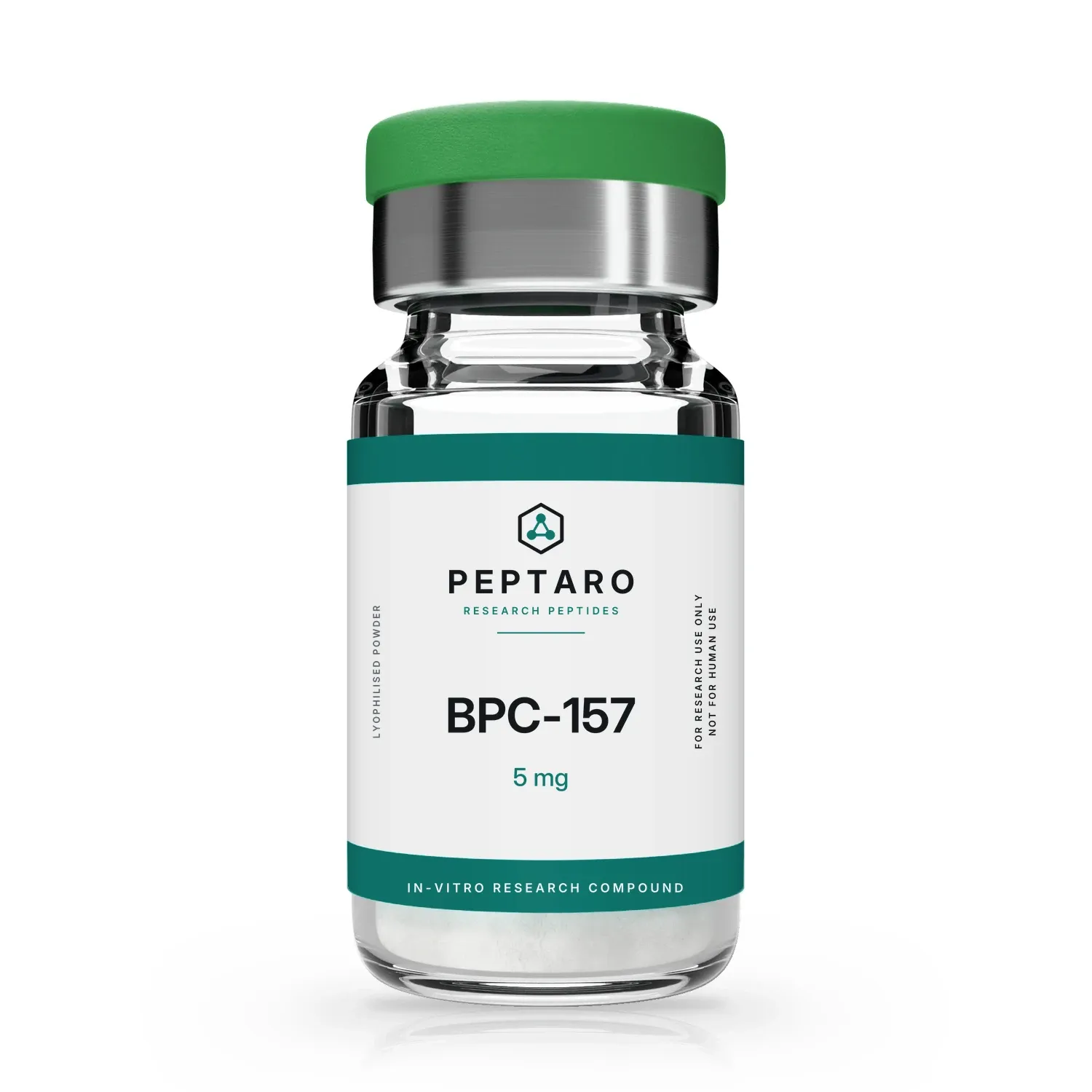
BPC-157
5mg · 10mg
In Stock · Ready to Shipfrom £16.95from £2.90/mg
99% RP-HPLCMarfleet Analytical Services LtdBatch UKPL-458
£23.99£0.48/mg
In Stock · Ready to Ship
Minimum order £299.00 per basket: mix any products. Research kits meet it on their own.
Dispatched same day if ordered by 3pm (Mon–Fri) · Royal Mail Tracked 24
| Vials in basket | Per vial | Saving |
|---|---|---|
| 1–2 | £23.99 | — |
| 3+ | £22.79 | 5% |
| 5+ | £22.07 | 8% |
| 10+ | £21.11 | 12% |
Discounts are basket-wide: mix any vials.
Documentation for each item ships with your order.
For in-vitro laboratory research use only. Not for human or veterinary use.
Documentation for each item ships with your order. The batch number printed on your vial matches it.
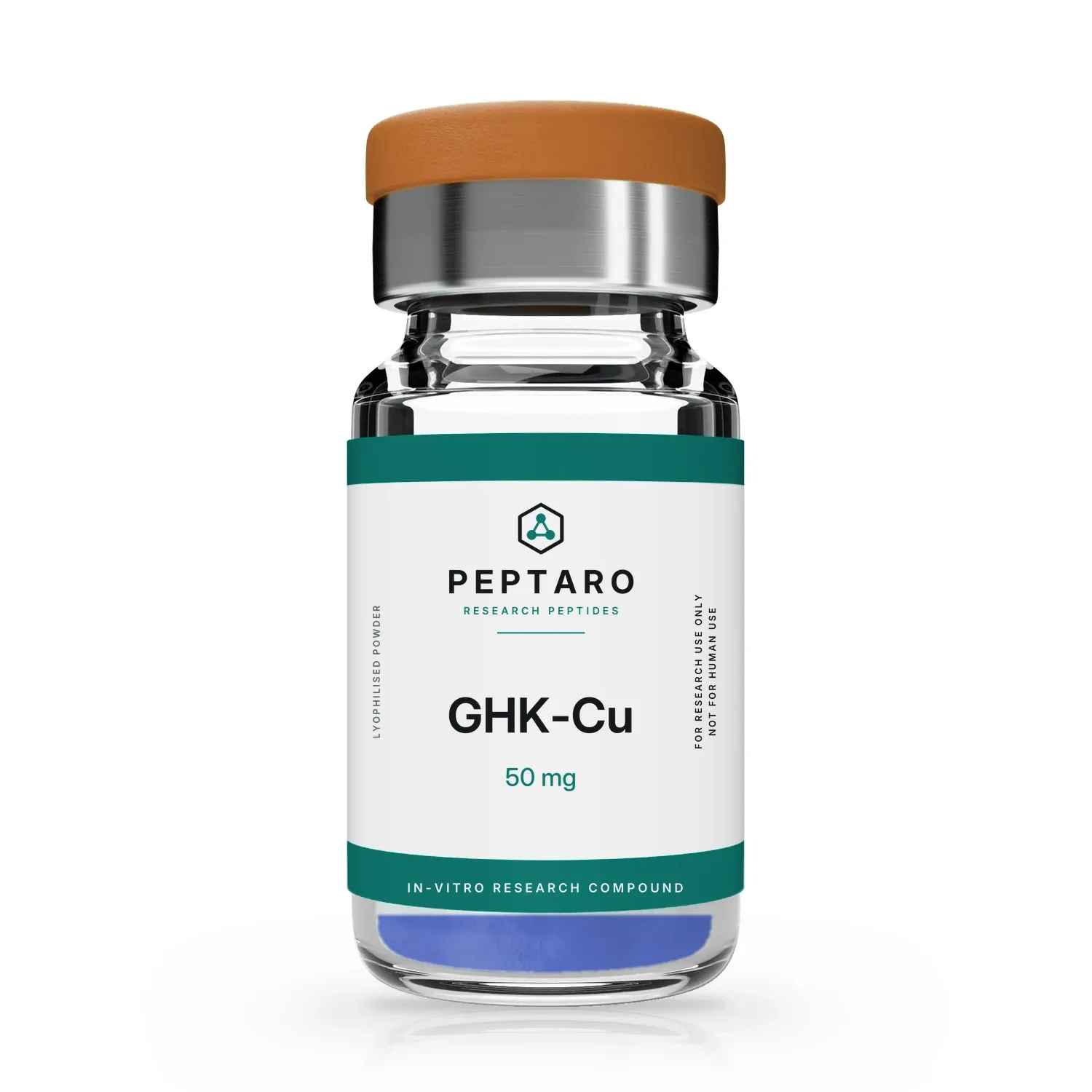
GHK-Cu 50mg is a smaller-content variant of the naturally occurring copper tripeptide complex. Same compound as our 100mg vial, half the lyophilised powder mass per vial for shorter protocols or pilot studies. Research has examined roles in tissue remodelling, anti-inflammatory pathways, antioxidant activity and gene expression related to collagen synthesis. Third-party tested.
GHK-Cu 50mg is the smaller vial of GHK-Cu, the copper(II) complex of the tripeptide glycyl-L-histidyl-L-lysine, also called copper tripeptide-1. It holds half the lyophilised powder of the 100mg vial, about 124 µmol of complex, as a blue powder.
The compound is identical in both vial sizes. Its copper transport role, its matrikine origin in type I collagen and the matrix and gene-expression literature are covered on the main GHK-Cu page. What differs at 50mg is the in-use window and the molar arithmetic.
The research uses match the 100mg vial: copper transport to copper-dependent enzymes, extracellular matrix biology such as collagen, glycosaminoglycan and matrix metalloproteinase-2 expression, and transcriptomic profiling. The 50mg vial is most useful for small-scale work that depends on an intact complex. Examples are spectrophotometry of the Cu(II) centre, stability studies across buffers, competition experiments with other chelators and method development for HPLC or ICP analysis.
Both vials hold the same complex, so the choice is about handling and cost. GHK-Cu is light-sensitive, and freeze-thaw can disturb the copper binding as well as the peptide. A 50mg vial is used up sooner, so one reconstituted stock sees fewer stopper punctures, less light and fewer freeze-thaw cycles. That suits pilot studies, method development, spectrophotometric work and any protocol that will not use 100mg promptly. The 100mg vial costs less per milligram, and one batch and certificate cover twice the work. Molar content is about 124 µmol against about 248 µmol.
This page covers the 50mg presentation of GHK-Cu, the copper(II) complex of glycyl-L-histidyl-L-lysine, molecular formula C₁₄H₂₄CuN₆O₄, molecular weight 403.9 g/mol, CAS 89030-95-5. The compound is identical to that in the 100mg vial, and the copper-shuttle model, matrikine classification and extracellular matrix literature are set out on the main GHK-Cu page. What this page addresses is what changes at half the vial content. The choice between 50mg and 100mg is mostly a question of in-use exposure rather than economy. GHK-Cu is a photolabile copper(II) complex, and freeze-thaw cycling can disrupt the copper coordination sphere independently of any damage to the peptide backbone. A 50mg vial is consumed across a shorter working life, which means fewer stopper penetrations, less cumulative light exposure and fewer freeze-thaw cycles on one reconstituted stock. For pilot studies, method development, or any protocol that will not consume 100mg inside a sensible in-use window, the smaller vial is the technically preferable choice rather than merely the cheaper one. The 100mg vial wins on cost per milligram and on batch continuity across a larger body of work. One arithmetic point is specific to this size, where a proportional error is easy to overlook. Molar calculations must use the mass of the complex, 403.9 g/mol, and not the free tripeptide at 340.4 g/mol. A 50mg vial of GHK-Cu therefore contains approximately 124 µmol of complex, whereas computing against the copper-free tripeptide would return roughly 147 µmol and overstate the figure by about 19 percent.
Keep sealed vials at -20°C, away from light and moisture. After reconstitution, keep the solution at 2-8°C in a light-proof container and use it within 4 weeks. Freeze-thaw can disturb the copper binding, so store single-use aliquots in amber or foil-wrapped vials at -20°C.
Vials are sold on their own, without bacteriostatic water for mixing or other supplies.
How to reconstitute and handle
Let the vial and the bacteriostatic water reach room temperature and swab both stoppers with alcohol. Add the water slowly down the inside wall of the vial, away from direct light, and swirl gently until the blue colour is even. Do not shake or vortex. A blue to blue-violet solution is expected. A colourless or green-tinged one means the complex has been disrupted, which absorbance at around 500 to 600 nm will confirm. Use glass or good polypropylene labware, not stainless steel, which can strip copper from the peptide.
For the full method, see the peptide reconstitution guide and the reconstitution calculator.
Published research on GHK-Cu is indexed on PubMed. See our full UK buyer's guide for GHK-Cu, UK buyer's guide for GHK-Cu 50mg and UK buyer's guide for GHK-Cu CoA.
| CAS number | 89030-95-5 |
|---|---|
| Molecular formula | C₁₄H₂₄CuN₆O₄ |
| Molecular weight | 403.9 g/mol |
| Sequence | Gly-L-His-L-Lys, copper(II) complex |
| Form | Lyophilised powder |
| Appearance | Blue to blue-violet lyophilised powder |
| Storage | -20°C lyophilised, 2-8°C reconstituted, protect from light |
Store sealed lyophilised vials at −20 °C, protected from light and moisture. For preparation, aliquoting and storage of reconstituted stock, see the laboratory reconstitution guide and the concentration calculator.
Choose 50mg for pilot work, method development, or any protocol that will not consume 100mg within a reasonable in-use window, and choose 100mg for extended work where cost per milligram and batch continuity matter more. The reasoning is not only economic. GHK-Cu is a photolabile copper complex whose coordination sphere is vulnerable to freeze-thaw cycling, so the smaller vial's shorter working life means fewer stopper penetrations, less light exposure and fewer freeze-thaw cycles on one stock.
Yes, identical. Both vials contain the same copper(II) tripeptide complex at 403.9 g/mol, CAS 89030-95-5, and the 50mg vial is not a diluted, blended or otherwise modified preparation. Only the mass per vial differs. Each vial size carries its own batch number and its own published certificate of analysis, so the purity figure for the 50mg vial applies to that batch rather than being carried over from the 100mg batch.
Approximately 124 µmol. Dividing 50mg by the complex molecular weight of 403.9 g/mol gives 0.1238 mmol, or about 124 micromoles. The common error here is calculating against the copper-free tripeptide at 340.4 g/mol, which returns roughly 147 µmol and overstates the true molar content by about 19 percent. The bound Cu(II) ion accounts for 63.5 g/mol of the complex mass, so the two figures are not interchangeable.
The current GHK-Cu 50mg batch is UKPL-458, verified at above 99% purity by HPLC, with the certificate of analysis published on this product page. One caveat applies to any metal-peptide complex: a purity figure reports the peptide, not the copper stoichiometry. Researchers who need the copper loading confirmed should verify it spectrophotometrically on receipt, since the visible absorption band around 500-600 nm reports directly on the intact Cu(II) centre.
Peptaro supplies GHK-Cu 50mg in the UK from stock, batch UKPL-458 at above 99% purity by HPLC, with the third-party certificate of analysis published on this page, dispatched the same day on orders placed before 3pm UK time. free tracked UK delivery on every order. The 100mg vial of the same compound is also stocked. Purchasers must be 18 or over and confirm research-only use. Not for human consumption or cosmetic application.
Buy 50mg if your work will not use 100mg promptly, and 100mg if cost per milligram and one batch across a long study matter more. The smaller vial also protects the light-sensitive copper complex, because a stock that is finished sooner is exposed less.
About 124 µmol. That uses the complex molecular weight of 403.9 g/mol. Using the free tripeptide weight of 340.4 g/mol gives about 147 µmol, which overstates the content by roughly 19 percent.
No. Peptaro supplies GHK-Cu 50mg strictly for in-vitro laboratory research. It is not a medicine and is not for human or veterinary use, and we don't give usage advice.
-20°C lyophilised, 2-8°C reconstituted, protect from light. For preparing and aliquoting stock solutions, see the laboratory reconstitution guide.
Orders placed by 3pm Monday to Friday (excluding bank holidays) are dispatched the same working day by Royal Mail Tracked 24. Delivery is free, tracked and cold-packed. The minimum order is £299.
5mg · 10mg
In Stock · Ready to Ship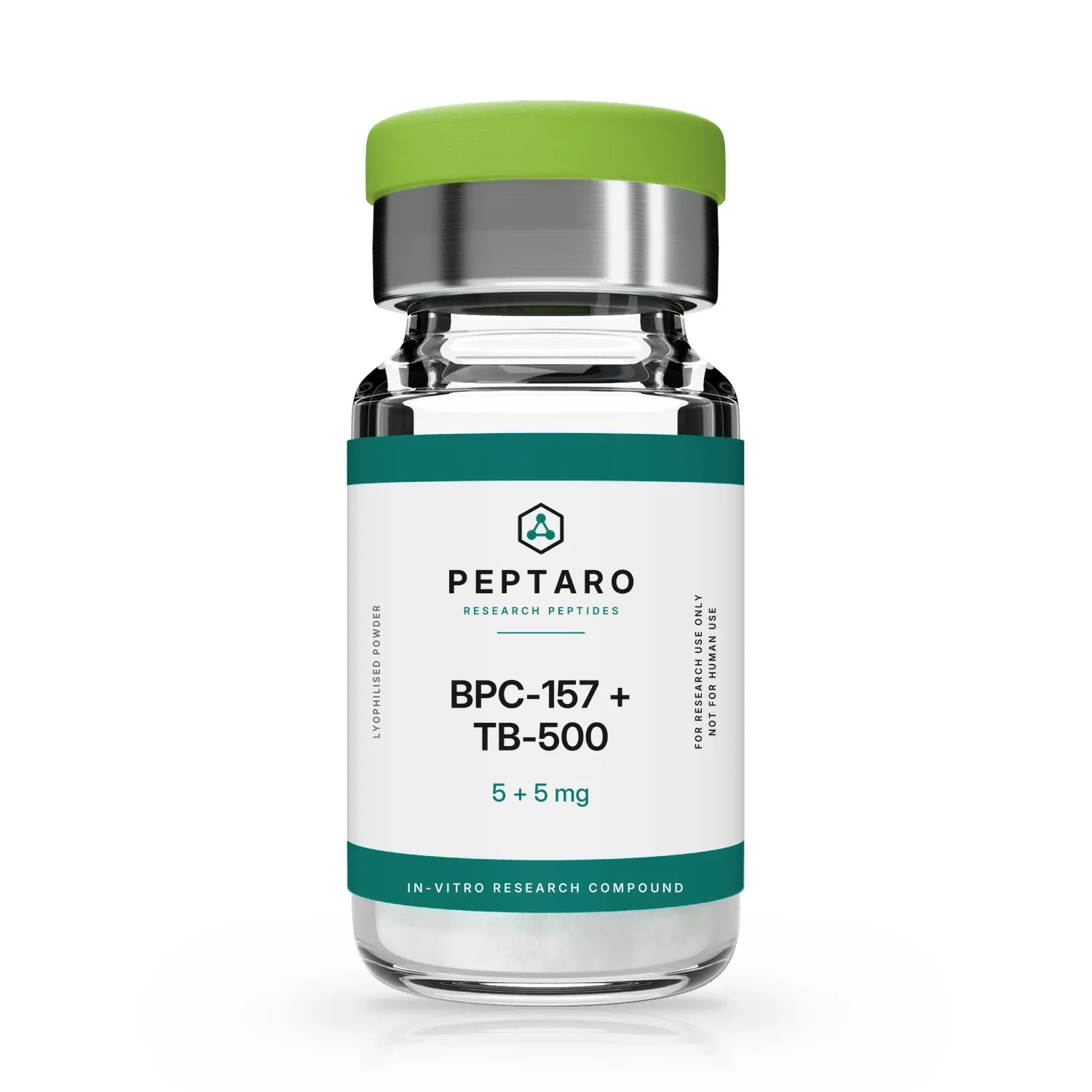
5+5mg · 10+10mg
In Stock · Ready to Ship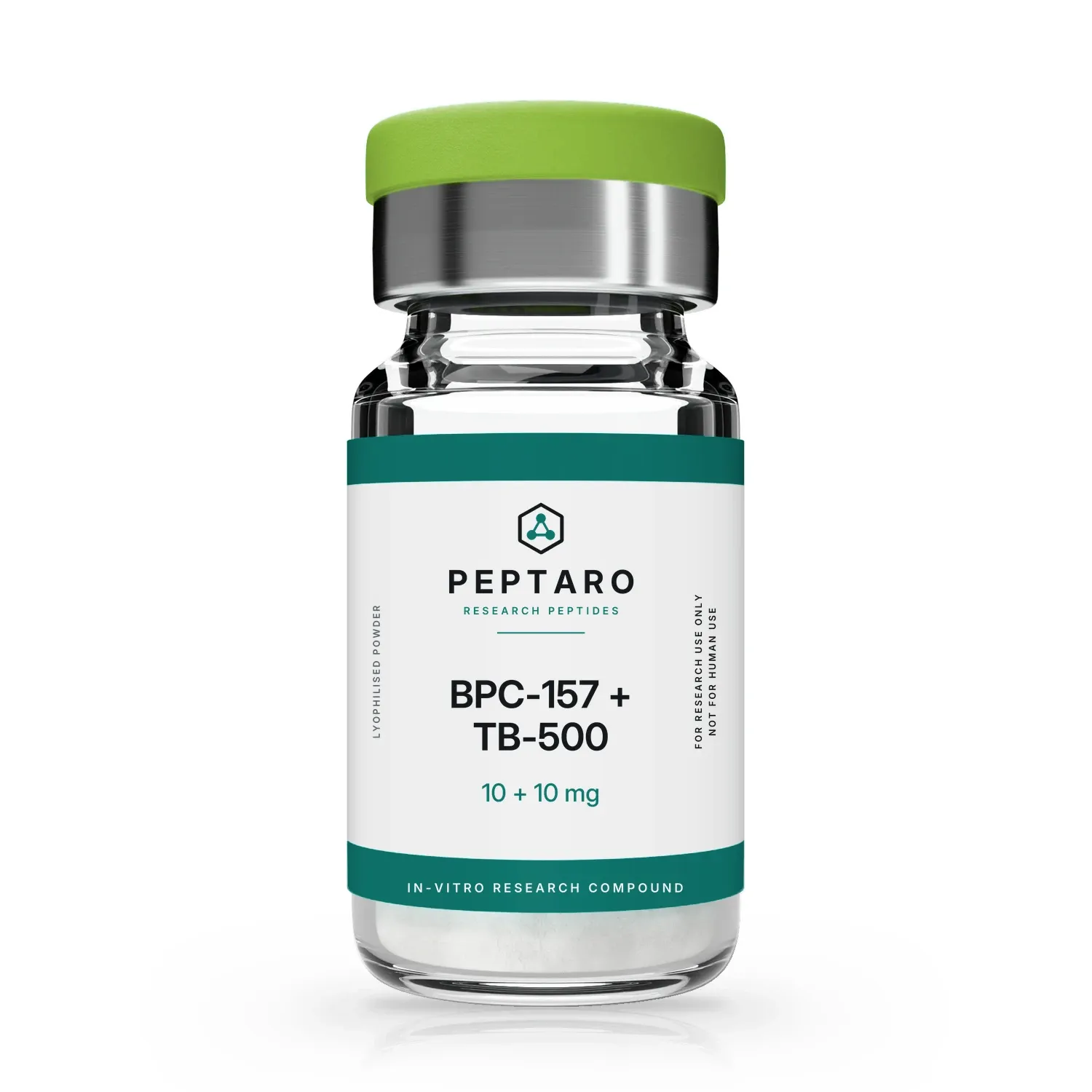
5+5mg · 10+10mg
In Stock · Ready to Ship
70mg
In Stock · Ready to ShipResearch use only. For in-vitro laboratory research use only. Not for human or veterinary use. By continuing you confirm you are 18+ and purchasing for laboratory research.