BPC-157
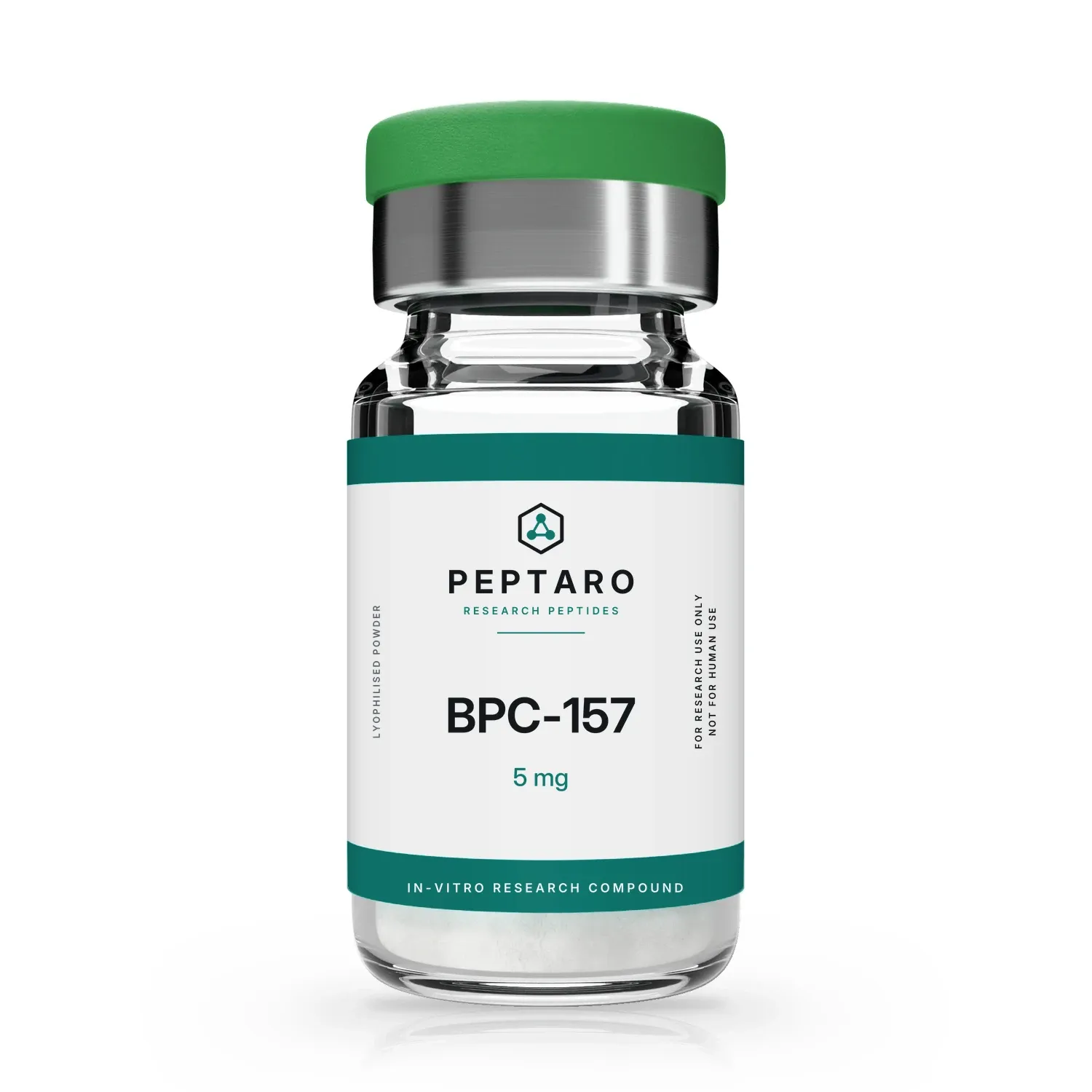
5mg · 10mg
In Stock · Ready to Shipfrom £16.95from £2.90/mg
£29.99£3.00/mg
In Stock · Ready to Ship
Minimum order £299.00 per basket: mix any products. Research kits meet it on their own.
Dispatched same day if ordered by 3pm (Mon–Fri) · Royal Mail Tracked 24
| Vials in basket | Per vial | Saving |
|---|---|---|
| 1–2 | £29.99 | — |
| 3+ | £28.49 | 5% |
| 5+ | £27.59 | 8% |
| 10+ | £26.39 | 12% |
Discounts are basket-wide: mix any vials.
Documentation for each item ships with your order.
For in-vitro laboratory research use only. Not for human or veterinary use.
Documentation for each item ships with your order. The batch number printed on your vial matches it.
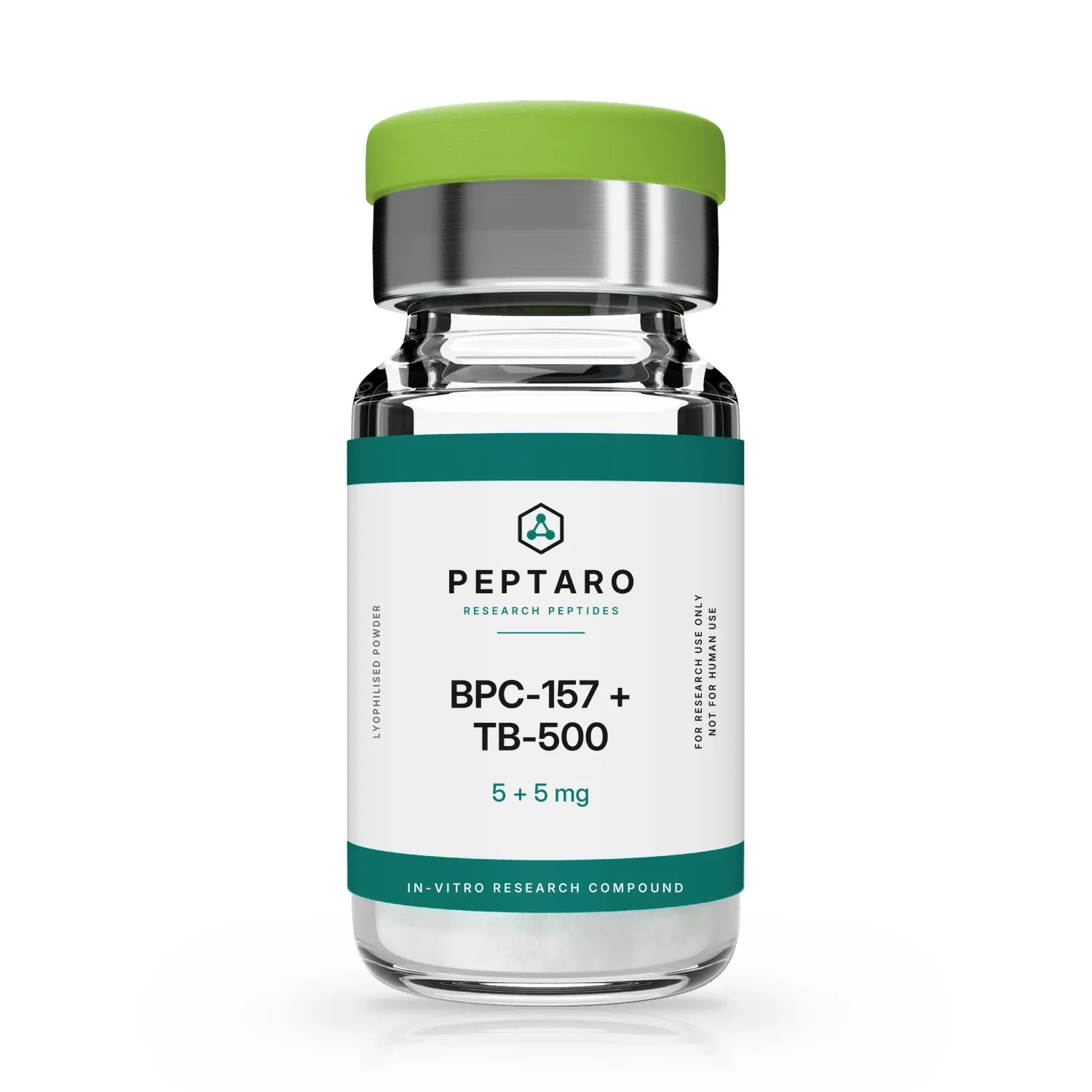
Pre-blended vial containing BPC-157 (Body Protection Compound, a 15 amino acid pentadecapeptide) and TB-500 (a synthetic fragment of thymosin beta-4). The two compounds are extensively referenced together in soft-tissue, angiogenesis and cell migration research. Supplying both as a single lyophilised vial reduces reconstitution steps for combined-protocol studies. Third-party tested.
This is a pre-blended vial of BPC-157 5mg and TB-500 5mg: 10mg of BPC-157/TB-500 powder in one lyophilised vial, under batch UKPL-2237. It is also written BPC157 TB500 or BPC 157 TB 500. One vial means one reconstitution and one solution for designs that use both peptides.
TB-500 and BPC-157 are chemically unrelated. BPC-157 is a 15-residue peptide taken from a protein first found in human gastric juice. TB-500 is specified here as N-acetylated thymosin beta 4, 43 residues. Each has its own product page covering its mechanism and literature.
What matters for the blend is format. Co-formulation saves preparation steps but removes independent control of each peptide. Equal mass is also not equal moles. No controlled study has tested this combination.
The blend suits preclinical soft-tissue and cell-migration designs that would otherwise run both peptides in parallel preparations. Its value is one reconstitution and one in-use window. No property arises from co-formulation itself, and no study has compared the pair against either peptide alone.
The blend wins on procedure. One vial needs one reconstitution and one fill volume, so there is no transfer step to add sterility risk or volume error. Both peptides share one reconstitution date. Separate vials win when the ratio must vary, when an effect has to be pinned to one peptide, or when only one is needed. Separate vials also make the molar imbalance obvious. 5mg of BPC-157 at 1419.53 g/mol is about 3.5 µmol, while 5mg of TB-500 at 4963.4 g/mol is about 1.0 µmol. The certificate for a blend also has to measure each peptide separately.
This is the pre-blended presentation, a single lyophilised vial containing BPC-157 5mg and TB-500 5mg, batch UKPL-2237. It is written various ways across the literature and the market, BPC 157 TB 500, BPC157 TB500, or simply the BPC-157 and TB-500 blend, and all refer to this same co-formulated vial. The pairing is also widely searched under its community nickname, the Wolverine stack, a forum name rather than a scientific term, and that too refers to this vial. The two compounds are chemically unrelated and their individual mechanisms and literatures are documented on the separate BPC-157 and TB-500 pages. What this page covers is the blend as a format, meaning what co-formulation gives a researcher and what it removes. What it gives is procedural. One vial means one reconstitution, one fill volume and one solution, which eliminates a transfer step along with its sterility and volumetric error from a combined-preparation design, and it means both components share a single reconstitution date and a single in-use window. What it removes is independent control, and there is an arithmetic consequence worth stating plainly. An equal-mass blend is not an equimolar blend. BPC-157 is a 15-residue pentadecapeptide at 1419.53 g/mol, while TB-500 is the 43-residue thymosin beta 4 sequence at 4963.4 g/mol. Five milligrams of each therefore corresponds to approximately 3.5 µmol of BPC-157 against approximately 1.0 µmol of TB-500, a molar ratio near 3.5 to 1 rather than 1 to 1, and any calculation expressed in molar terms has to account for that. The honest position on the pairing is that no controlled study has evaluated this specific combination. Both compounds have substantial independent preclinical literatures and are frequently run alongside one another in tissue-repair designs because the reported mechanisms are distinct rather than redundant, but combination-specific data does not exist. Separate vials remain preferable wherever the two need to be varied independently or an observation attributed to one mechanism. Research use only.
Keep sealed vials at -20°C, away from light and moisture. After reconstitution, keep the solution at 2-8°C and use it within 4 weeks, or freeze single-use aliquots at -20°C. Both peptides share one reconstitution date, so the shorter in-use window governs the whole vial. Freeze-thaw cycles cut recovery of the thymosin beta 4 chain in particular.
Vials are sold on their own, without bacteriostatic water for mixing or other supplies.
How to reconstitute and handle
Treat the vial as one 10mg preparation, with the fill volume set by the concentration your protocol needs. Let the vial and the bacteriostatic water reach room temperature and swab both stoppers. Add the water slowly down the inside wall and swirl gently until dissolved. Do not shake or vortex: the thymosin beta 4 chain is shear-sensitive. The solution should be clear and colourless. The two peptides cannot be separated after reconstitution. Label the vial with fill volume, concentration and date.
For the full method, see the peptide reconstitution guide and the reconstitution calculator.
Published research on BPC-157 + TB-500 is indexed on PubMed. See our full UK buyer's guide for BPC-157 + TB-500 and UK buyer's guide for Wolverine Stack.
| CAS number | 137525-51-0 |
|---|---|
| Molecular weight | 1419.53 g/mol |
| Form | Lyophilised powder (co-formulated) |
| Appearance | White lyophilised powder (single vial) |
| Storage | -20°C lyophilised, 2-8°C reconstituted |
Store sealed lyophilised vials at −20 °C, protected from light and moisture. For preparation, aliquoting and storage of reconstituted stock, see the laboratory reconstitution guide and the concentration calculator.
It is a single lyophilised vial co-formulated with 5mg of BPC-157 and 5mg of TB-500, 10mg of total peptide, supplied under one batch number with one certificate of analysis reporting each component separately. BPC-157 is a 15-residue pentadecapeptide at 1419.53 g/mol and TB-500 is the 43-residue thymosin beta 4 sequence at 4963.4 g/mol. The blend exists to reduce preparation steps in combined-protocol research.
It is 1:1 by mass but not by moles, and the distinction matters for any molar calculation. BPC-157 has a molecular weight of 1419.53 g/mol and TB-500 of 4963.4 g/mol, so 5mg of each corresponds to roughly 3.5 µmol against roughly 1.0 µmol, a molar ratio near 3.5 to 1 in favour of BPC-157. A vial described as an equal-mass blend is therefore substantially BPC-157-weighted in molar terms.
Almost entirely for procedural reasons. A co-formulated vial requires one reconstitution rather than two, uses one fill volume and one solution, and removes a transfer step along with the sterility and volumetric error that step introduces. Both components also share a single reconstitution date and in-use window, which simplifies record-keeping. The pairing itself is common in preclinical tissue-repair designs because the two reported mechanisms are distinct rather than overlapping.
No controlled study has evaluated this specific combination, and that should be stated plainly rather than implied otherwise. Each compound has an extensive independent preclinical literature, BPC-157 centred on VEGFR2 signalling and focal adhesion kinase phosphorylation, thymosin beta 4 on G-actin sequestration and integrin-linked kinase activation. What does not exist is data demonstrating that the two together produce an effect beyond either alone. Any expectation of combination synergy is an assumption, not a published finding.
Per component, not as a single number. A meaningful certificate of analysis for a co-formulated vial has to resolve two chemically distinct species, a 1419 Da peptide and a 4963 Da peptide. Batch UKPL-2237 is verified by Janoshik Analytical (report #229864, Sep 2026) with a per-component content assay: 6.10mg BPC-157 and 5.64mg TB-500 measured in the vial. The report quantifies each component independently rather than quoting one aggregate figure, which is what makes it meaningful for a blend.
Peptaro supplies a pre-blended BPC-157 and TB-500 vial in the UK, 5mg plus 5mg, batch UKPL-2237, content-verified by Janoshik Analytical at 6.10mg BPC-157 and 5.64mg TB-500, with the certificate of analysis published on this page and same-day dispatch on orders placed before 3pm UK time. free tracked UK delivery on every order. Individual 5mg vials of each compound are also stocked for protocols needing them separately. Research use only, purchasers must be 18 or over.
Yes. The certificate for batch UKPL-2237 is published on this product page, and the batch record can be independently checked at /verify, which carries the Janoshik Analytical report #229864 (Sep 2026) on a per-batch verification page. tracked UK delivery is free on every order, dispatched the same day on orders placed before 3pm UK time on a working day.
No. It is equal by mass and about 3.5 to 1 by moles in favour of BPC-157. At 1419.53 g/mol and 4963.4 g/mol, 5mg of each is about 3.5 µmol against 1.0 µmol. Any protocol written in molar terms must allow for that.
No controlled study has tested this combination. Each peptide has its own preclinical literature, and they are often paired in tissue-repair designs because their reported mechanisms differ. No published work shows the pair does more than either alone. The blend is a format for convenience, not evidence of a combined effect.
No. Peptaro supplies BPC-157 + TB-500 5+5mg strictly for in-vitro laboratory research. It is not a medicine and is not for human or veterinary use, and we don't give usage advice.
-20°C lyophilised, 2-8°C reconstituted. For preparing and aliquoting stock solutions, see the laboratory reconstitution guide.
Orders placed by 3pm Monday to Friday (excluding bank holidays) are dispatched the same working day by Royal Mail Tracked 24. Delivery is free, tracked and cold-packed. The minimum order is £299.
Research use only. For in-vitro laboratory research use only. Not for human or veterinary use. By continuing you confirm you are 18+ and purchasing for laboratory research.