GHK-Cu
50mg · 100mg
In Stock · Ready to Shipfrom £23.99from £0.33/mg
98.92% RP-HPLCJanoshikBatch UKPL-9511
£19.99£2.00/mg
In Stock · Ready to Ship
Minimum order £299.00 per basket: mix any products. Research kits meet it on their own.
Dispatched same day if ordered by 3pm (Mon–Fri) · Royal Mail Tracked 24
| Vials in basket | Per vial | Saving |
|---|---|---|
| 1–2 | £19.99 | — |
| 3+ | £18.99 | 5% |
| 5+ | £18.39 | 8% |
| 10+ | £17.59 | 12% |
Discounts are basket-wide: mix any vials.
Documentation for each item ships with your order.
For in-vitro laboratory research use only. Not for human or veterinary use.
Documentation for each item ships with your order. The batch number printed on your vial matches it.
SNAP-8 is an acetyl octapeptide (Glu-Glu-Met-Gln-Arg-Arg-Ala-Asp-NH2) designed to extend the sequence of acetyl hexapeptide-3. Research has examined its reported inhibition of SNARE complex formation and catecholamine release in models of neuromuscular signalling, with applications studied primarily in cosmetic science. Supplied as lyophilised powder, supplier-tested, with the certificate published on this page and independent third-party verification pending.
SNAP-8 is an acetyl octapeptide (Glu-Glu-Met-Gln-Arg-Arg-Ala-Asp-NH2) designed to extend the sequence of acetyl hexapeptide-3. Research has examined its reported inhibition of SNARE complex formation and catecholamine release in models of neuromuscular signalling, with applications studied primarily in cosmetic science.
SNAP-8, catalogued as acetyl octapeptide-3, has the sequence Ac-Glu-Glu-Met-Gln-Arg-Arg-Ala-Asp-NH₂. Its formula is C₄₁H₇₀N₁₆O₁₆S, its molecular weight about 1075 g/mol and its CAS number 868844-74-0. It was designed for cosmetic science as an extension of acetyl hexapeptide-3 (Argireline), with alanine and aspartate added at the C-terminus. It is a cosmetic ingredient, not a medicine.
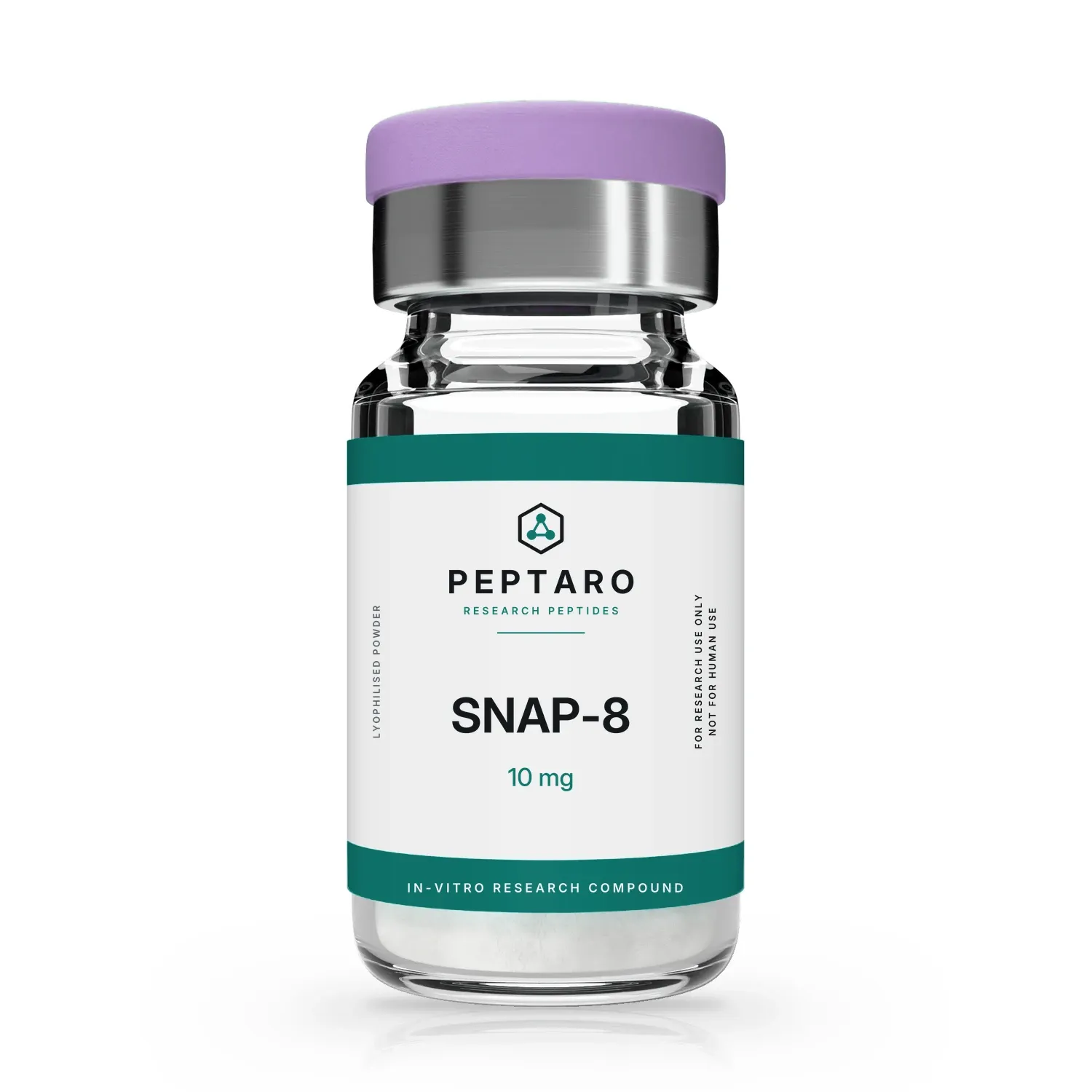
Both peptides copy the N-terminal region of SNAP-25, the 25 kDa protein that gives two helices to the neuronal SNARE complex. That four-helix complex drives calcium-dependent vesicle fusion, and botulinum neurotoxin A cleaves SNAP-25 at the neuromuscular junction. Each SNAP-8 10mg vial holds white lyophilised powder.
Typical in-vitro work covers SNARE assembly assays, competition against native SNAP-25 and syntaxin, and exocytosis models. In cosmetic science it belongs to the neurotransmitter-inhibitor peptides, one of the classes catalogued by Pintea and colleagues (Biomolecules, 2025). Poor membrane permeability is a known limit of that class. The mechanistic literature is small and comes mostly from one group.
The two share six residues. Argireline is Ac-Glu-Glu-Met-Gln-Arg-Arg-NH₂, about 889 g/mol. SNAP-8 adds Ala-Asp at the C-terminus, reaching about 1075 g/mol and matching SNAP-25 residues 12 to 19. Both are proposed to compete with native SNAP-25 for SNARE complex assembly. The published record separates them. The hexapeptide has its own paper, with in-vitro release data and a volunteer study (Blanes-Mira et al., Int J Cosmet Sci, 2002). It inhibited neurotransmitter release with a potency similar to botulinum toxin A, but with much lower efficacy. The octapeptide has no comparable paper of its own; its case rests on the same group's work on N-terminal SNAP-25 peptides (J Neurochem, 2004) and on manufacturer dossiers. Head-to-head data are sparse, so the Ala-Asp extension is the variable under test.
SNAP-8, catalogued as acetyl octapeptide-3, is a synthetic eight-residue peptide with the sequence Ac-Glu-Glu-Met-Gln-Arg-Arg-Ala-Asp-NH₂, molecular formula C₄₁H₇₀N₁₆O₁₆S and molecular weight approximately 1075 g/mol (CAS 868844-74-0). It was designed as an extended form of acetyl hexapeptide-3 (Argireline), the six-residue peptide Ac-Glu-Glu-Met-Gln-Arg-Arg-NH₂, by adding an alanine and an aspartate at the C-terminus, and it was developed and marketed for cosmetic science by Lipotec. Both sequences are patterned after the N-terminal region of SNAP-25, the synaptosome-associated 25 kDa protein of the neuronal SNARE complex. SNAP-25 contributes two helices to this four-helix assembly, which drives calcium-dependent vesicle fusion at the synapse, and it is the substrate cleaved by botulinum neurotoxin A at the neuromuscular junction. Peptides that mimic its N-terminal domain are proposed to compete with native SNAP-25 for complex formation. The reference mechanistic work is Blanes-Mira and colleagues (J Neurochem, 2004), who reported that such peptides inhibit SNARE complex assembly and calcium-dependent catecholamine exocytosis in chromaffin cell models. Research interest in SNAP-8 is therefore centred on models of neuromuscular signalling, with applications studied primarily in cosmetic science as a botulinum-toxin-mimetic model peptide, a class catalogued by Pintea and colleagues (Biomolecules, 2025).
The chromaffin cell model that underpins this field predates the peptide itself: Gutierrez and colleagues (J Biol Chem, 1997) used C-terminal SNAP-25 peptides to block secretory vesicle docking in chromaffin cells, establishing the experimental system in which the later N-terminal peptide series was characterised.
The honest boundary of the evidence is worth stating plainly. The peer-reviewed mechanistic literature is small and originates largely from a single research group. The octapeptide has no published, independent, randomised cosmetic trial of its own; most efficacy figures circulating for it trace to manufacturer technical dossiers rather than journals. And the widely quoted 30% wrinkle-depth figure belongs to the hexapeptide's small open-label volunteer study (Blanes-Mira et al., Int J Cosmet Sci, 2002), not to the octapeptide. SNAP-8 holds no marketing authorisation in any jurisdiction and is supplied as lyophilised powder for in-vitro laboratory research only.
Peptaro supplies SNAP-8 10mg at £19.99, batch UKPL-9511, supplier-tested at 98.92% purity by RP-HPLC, with the certificate of analysis published on this page and independent third-party verification pending.
Move vials to the freezer on arrival; the powder tolerates short transit at room temperature. Oxidation of methionine 3 is the main risk in solution. Keep vials tightly sealed with little headspace, protect them from light, and freeze single-use aliquots for longer storage. Discard any solution that turns cloudy.
Vials are sold on their own, without bacteriostatic water for mixing or other supplies.
How to reconstitute and handle
For the full method, see the peptide reconstitution guide and the reconstitution calculator.
Published research on SNAP-8 is indexed on PubMed. See our full UK buyer's guide for SNAP-8.
| CAS number | 868844-74-0 |
|---|---|
| Molecular formula | C₄₁H₇₀N₁₆O₁₆S |
| Molecular weight | ≈1075.2 g/mol |
| Sequence | Ac-Glu-Glu-Met-Gln-Arg-Arg-Ala-Asp-NH₂ |
| Form | Lyophilised powder |
| Appearance | White lyophilised powder |
| Release specification | ≥98.0% |
| Storage | -20°C lyophilised, 2-8°C reconstituted |
Store sealed lyophilised vials at −20 °C, protected from light and moisture. For preparation, aliquoting and storage of reconstituted stock, see the laboratory reconstitution guide and the concentration calculator.
Botulinum neurotoxin A paralyses muscle by cleaving SNAP-25, which disables the SNARE complex that drives neurotransmitter release. SNAP-8 is a short peptide patterned after the N-terminal region of that same protein, and the mechanistic literature reports that such peptides inhibit SNARE complex formation and calcium-dependent catecholamine exocytosis in chromaffin cell models (Blanes-Mira et al., J Neurochem, 2004). It is a research model of that signalling pathway, not a toxin and not a medicine, and no therapeutic equivalence is claimed.
Argireline is the hexapeptide Ac-Glu-Glu-Met-Gln-Arg-Arg-NH₂ at approximately 889 g/mol; SNAP-8 extends that sequence with alanine and aspartate at the C-terminus, giving Ac-Glu-Glu-Met-Gln-Arg-Arg-Ala-Asp-NH₂ at approximately 1075 g/mol (CAS 868844-74-0). The hexapeptide carries the published cosmetic study reporting up to 30% wrinkle-depth reduction after 30 days in a small open-label volunteer study (Blanes-Mira et al., Int J Cosmet Sci, 2002); published head-to-head data for the octapeptide are sparse.
SNAP-8 is used in in-vitro research on the SNAP-25 component of the neuronal SNARE complex, including SNARE assembly assays and models of calcium-dependent catecholamine exocytosis in chromaffin cells (Blanes-Mira et al., J Neurochem, 2004), with applications studied primarily in cosmetic science.
SNAP-8 is not a Controlled Drug, and it may lawfully be bought and held in the UK as a research chemical for in-vitro laboratory use. It is not a licensed medicine anywhere, and under the Human Medicines Regulations 2012 it cannot lawfully be sold or supplied for human consumption. Purchasers must be 18 or over and confirm research-only use at checkout.
Peptaro sells SNAP-8 10mg vials from UK stock. Orders placed before 3pm on a working day are dispatched the same day by Royal Mail Tracked, and tracked UK delivery is free on every order. It is sold for in-vitro research only, to buyers aged 18 or over.
Yes, by the supplier. Their analysis of batch UKPL-9511 reports 98.92% purity by RP-HPLC and 9.89mg measured content against the 10mg label. Independent third-party testing is pending. The certificate is published with this listing, and its batch number matches the one printed on the vial.
No. Peptaro supplies SNAP-8 10mg strictly for in-vitro laboratory research. It is not a medicine and is not for human or veterinary use, and we don't give usage advice.
-20°C lyophilised, 2-8°C reconstituted. For preparing and aliquoting stock solutions, see the laboratory reconstitution guide.
Orders placed by 3pm Monday to Friday (excluding bank holidays) are dispatched the same working day by Royal Mail Tracked 24. Delivery is free, tracked and cold-packed. The minimum order is £299.
Research use only. For in-vitro laboratory research use only. Not for human or veterinary use. By continuing you confirm you are 18+ and purchasing for laboratory research.