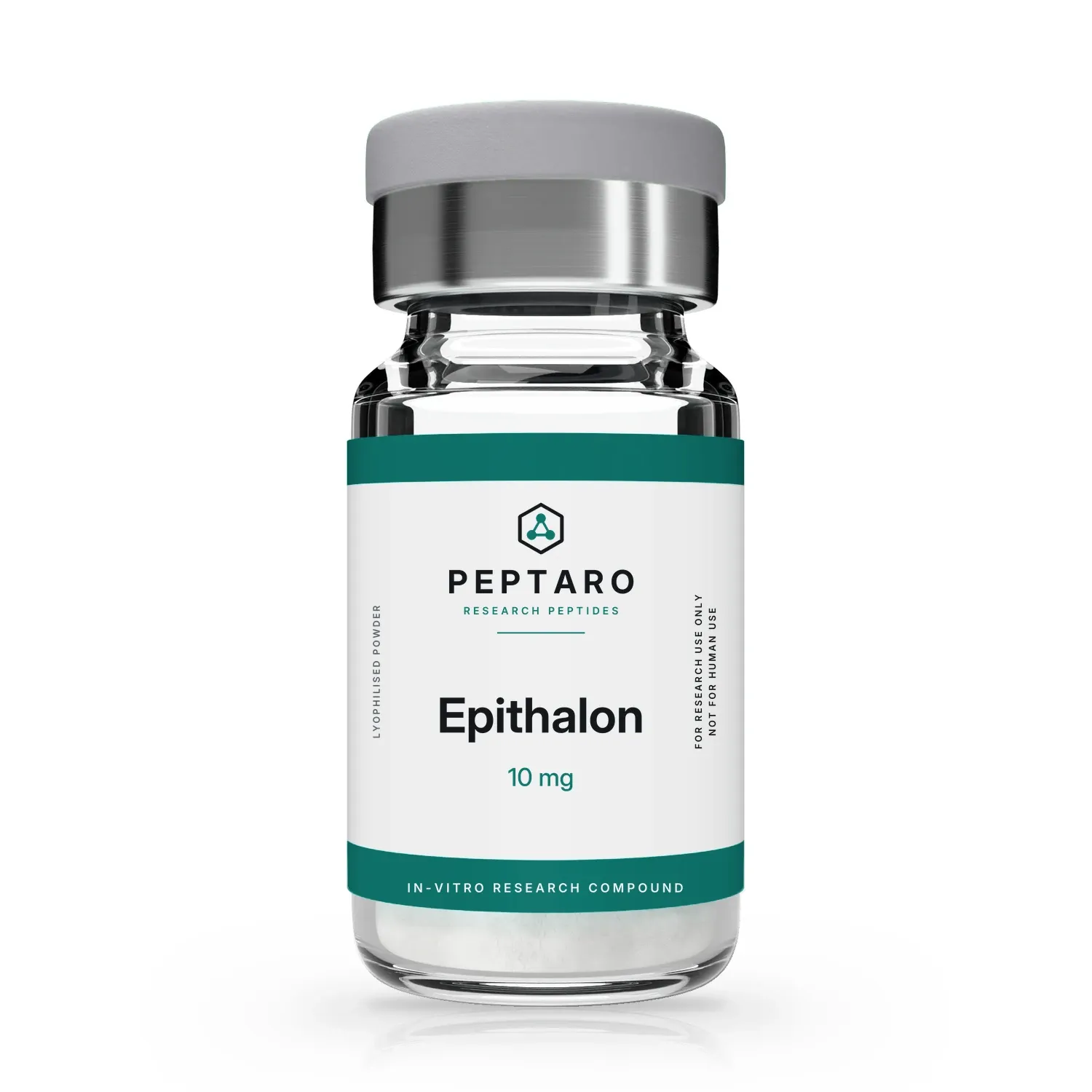
Epithalon
10mg
Out of stock£17.99£1.80/mg
98.82% RP-HPLCJanoshikBatch UKPL-9510
£22.99£2.30/mg
In Stock · Ready to Ship
Minimum order £299.00 per basket: mix any products. Research kits meet it on their own.
Dispatched same day if ordered by 3pm (Mon–Fri) · Royal Mail Tracked 24
| Vials in basket | Per vial | Saving |
|---|---|---|
| 1–2 | £22.99 | — |
| 3+ | £21.84 | 5% |
| 5+ | £21.15 | 8% |
| 10+ | £20.23 | 12% |
Discounts are basket-wide: mix any vials.
Documentation for each item ships with your order.
For in-vitro laboratory research use only. Not for human or veterinary use.
Documentation for each item ships with your order. The batch number printed on your vial matches it.
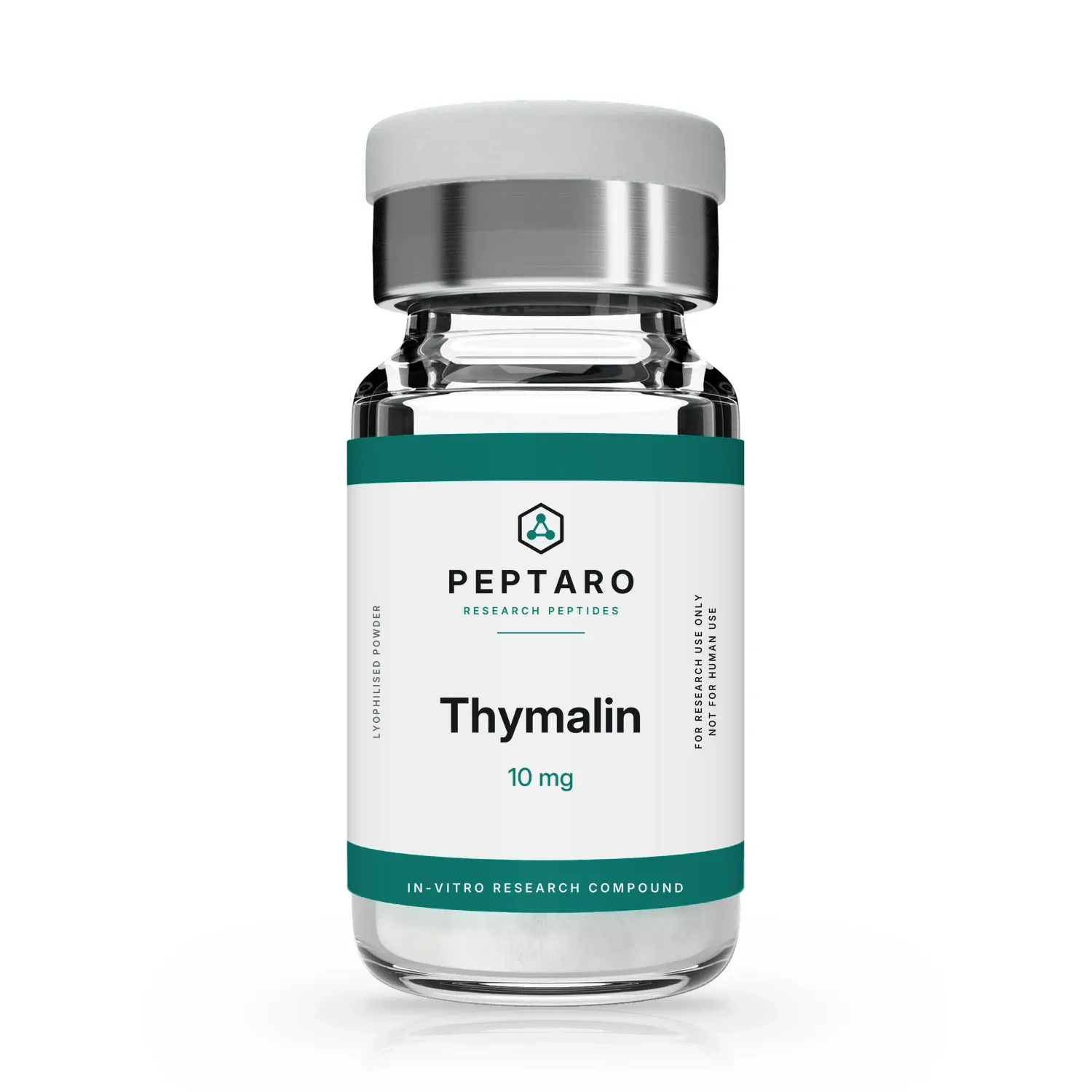
Thymalin is the thymus-derived dipeptide Glu-Trp, also referred to as timogen, first isolated from calf thymus extracts in the Soviet immunomodulator research programme. Research on thymus peptides has examined their reported effects on T-cell function and immune restoration in aged animal models. Supplied as lyophilised powder, supplier-tested, with the certificate published on this page and independent third-party verification pending.
Thymalin is the thymus-derived dipeptide Glu-Trp, also referred to as timogen, first isolated from calf thymus extracts in the Soviet immunomodulator research programme. Research on thymus peptides has examined their reported effects on T-cell function and immune restoration in aged animal models.
The vial holds L-glutamyl-L-tryptophan (EW), the molecule named on the batch certificate. In the Russian literature, Thymalin is the natural peptide complex from calf thymus. Glu-Trp was isolated from it by reversed-phase HPLC, synthesised and developed as a separate product, Thymogen (Morozov and Khavinson, Int J Immunopharmacol, 1997). Its international nonproprietary name is oglufanide.
The tryptophan sets the chemistry. Its indole side chain absorbs UV light strongly and oxidises in solution. Each Thymalin 10mg vial holds white lyophilised powder.
Typical endpoints are T-cell function assays, T- and B-lymphocyte subset analysis and models of age-related immune decline. Most primary data come from one research group, much of it in Russian. The human evidence is small and does not meet modern regulatory standards. Thymalin and Thymogen were developed as pharmaceuticals by the same group, but neither has marketing authorisation in the UK, the EU or the United States.
The names differ by one letter and describe different molecules. Thymalin, as supplied here, is the dipeptide Glu-Trp, 333.34 g/mol, CAS 38101-59-6. Thymulin, once called facteur thymique sérique (FTS), is a nonapeptide, pGlu-Ala-Lys-Ser-Gln-Gly-Gly-Ser-Asn, with a pyroglutamate N-terminus. Bach and colleagues characterised it as a serum thymic factor (Nature, 1977), and its activity was later shown to depend on bound zinc. Both come from the thymus and sit in the immunology literature, but they are chemically unrelated. Check which molecule a paper used before carrying a protocol or citation from one to the other.
Thymalin, as supplied here, is the thymus-derived dipeptide L-glutamyl-L-tryptophan, written Glu-Trp and in one-letter code EW, with the molecular formula C₁₆H₁₉N₃O₅, a molecular weight of 333.34 g/mol and CAS number 38101-59-6. It is the synthetic dipeptide also referred to as timogen (also written thymogen). The name carries a precise history: thymalin originally denoted a polypeptide complex isolated from calf thymus extracts in the Soviet immunomodulator research programme by Morozov and Khavinson (Biokhimiya, 1981), and the Glu-Trp dipeptide was later separated from that complex by reversed-phase HPLC, synthesised and taken forward as a discrete immunomodulatory molecule (Morozov and Khavinson, Int J Immunopharmacol, 1997; Khavinson et al., Biol Bull Rev, 2021).
Research on thymus peptides has examined their reported effects on T-cell function and immune restoration in aged animal models. The English-language review by Khavinson and colleagues (Biol Bull Rev, 2021) summarises the reported immunoprotective effects of the thymus peptides: restoration of the number and ratio of T and B lymphocytes and their subpopulations, an increase in their functional activity, and increased phagocytosis in immunodepressed states. Anisimov and Khavinson (Biogerontology, 2010) review the same programme's geroprotective work across the thymus and pineal preparations. For the dipeptide specifically, the defining animal study is Anisimov, Khavinson and Morozov (Biogerontology, 2000), who reported that L-Glu-L-Trp slowed the ageing rate, increased survival and decreased spontaneous tumour incidence, roughly 1.5-fold, in outbred female rats.
The chemistry worth knowing before experimental design is concentrated in the tryptophan residue. The indole side chain absorbs UV light strongly, which makes the dipeptide convenient to follow spectrophotometrically, and it oxidises readily in solution, which is the degradation route to design against in handling and storage.
It is worth being direct about two things. First, the evidence base: the primary data originate overwhelmingly from one affiliated research cluster, much of it is Russian-language, the human evidence is small and does not meet modern regulatory standards, and thymalin holds no marketing authorisation in the UK, the EU or the United States. Second, the naming: thymulin, the distinct zinc-dependent nonapeptide characterised by Bach and colleagues (Nature, 1977), is a different molecule with a different literature, and the two names are routinely confused.
Move vials to the freezer on arrival and keep them dark and dry. Oxidation of the tryptophan indole ring is the main risk in solution. Keep vials tightly sealed with little headspace, protect them from light, and keep oxidising agents away. Freeze single-use aliquots for longer storage.
Vials are sold on their own, without bacteriostatic water for mixing or other supplies.
How to reconstitute and handle
For the full method, see the peptide reconstitution guide and the reconstitution calculator.
Published research on Thymalin is indexed on PubMed. See our full UK buyer's guide for Thymalin.
| CAS number | 38101-59-6 |
|---|---|
| Molecular formula | C₁₆H₁₉N₃O₅ |
| Molecular weight | 333.34 g/mol |
| Sequence | Glu-Trp (EW) |
| Form | Lyophilised powder |
| Appearance | White lyophilised powder |
| Release specification | ≥98.0% |
| Storage | -20°C lyophilised, 2-8°C reconstituted |
Store sealed lyophilised vials at −20 °C, protected from light and moisture. For preparation, aliquoting and storage of reconstituted stock, see the laboratory reconstitution guide and the concentration calculator.
No. Thymulin, historically called facteur thymique sérique, is a distinct nonapeptide with the sequence Glu-Ala-Lys-Ser-Gln-Gly-Gly-Ser-Asn whose biological activity depends on zinc coordination, first characterised by Bach and colleagues (Nature, 1977). Thymalin, as supplied here, is the two-residue dipeptide Glu-Trp. The two molecules come from the same organ and share an immunology-adjacent literature, but they are chemically unrelated, and the similar names are a common source of confusion.
The original thymalin was a polypeptide complex isolated from calf thymus extracts and reported by Morozov and Khavinson (Biokhimiya, 1981) within the Soviet immunomodulator research programme. The Glu-Trp dipeptide was later separated from that complex by reversed-phase HPLC, synthesised, and studied as a discrete immunomodulatory molecule, a history set out in English by Morozov and Khavinson (Int J Immunopharmacol, 1997) and Khavinson and colleagues (Biol Bull Rev, 2021).
Research on thymus peptides has examined reported effects on T-cell function and immune restoration in aged animal models. Khavinson and colleagues (Biol Bull Rev, 2021) summarise reported restoration of T and B lymphocyte numbers and subpopulations, increased functional activity and increased phagocytosis, and Anisimov, Khavinson and Morozov (Biogerontology, 2000) reported that the L-Glu-L-Trp dipeptide slowed ageing, increased survival and reduced spontaneous tumour incidence in rats. The human evidence is thin and largely Russian-language.
Every batch of Thymalin 10mg is supplier-tested and the certificate of analysis is published on the product page rather than supplied on request. Batch UKPL-9510 is verified at 98.82% purity by RP-HPLC, independent third-party verification is pending, and the batch number on the certificate matches the batch number printed on the vial you receive. Supplied for in-vitro laboratory research only.
Peptaro sells Thymalin 10mg vials from UK stock. Orders placed before 3pm on a working day are dispatched the same day by Royal Mail Tracked, and tracked UK delivery is free on every order. It is sold for in-vitro research only, to buyers aged 18 or over.
Yes. The supplier's analysis of batch UKPL-9510 reports 98.82% purity by RP-HPLC and 9.96mg measured content against the 10mg label. Independent third-party testing is pending. The certificate is published with this listing, and its batch number matches the one printed on the vial.
Immunology and ageing research. Studies look at T-cell function and lymphocyte subsets in aged or immunodepressed animal models, following the thymus-peptide work reviewed by Khavinson and colleagues (Biol Bull Rev, 2021). The key dipeptide study measured lifespan and tumour incidence in rats (Anisimov, Khavinson and Morozov, Biogerontology, 2000).
No. Peptaro supplies Thymalin 10mg strictly for in-vitro laboratory research. It is not a medicine and is not for human or veterinary use, and we don't give usage advice.
Research use only. For in-vitro laboratory research use only. Not for human or veterinary use. By continuing you confirm you are 18+ and purchasing for laboratory research.