Adamax
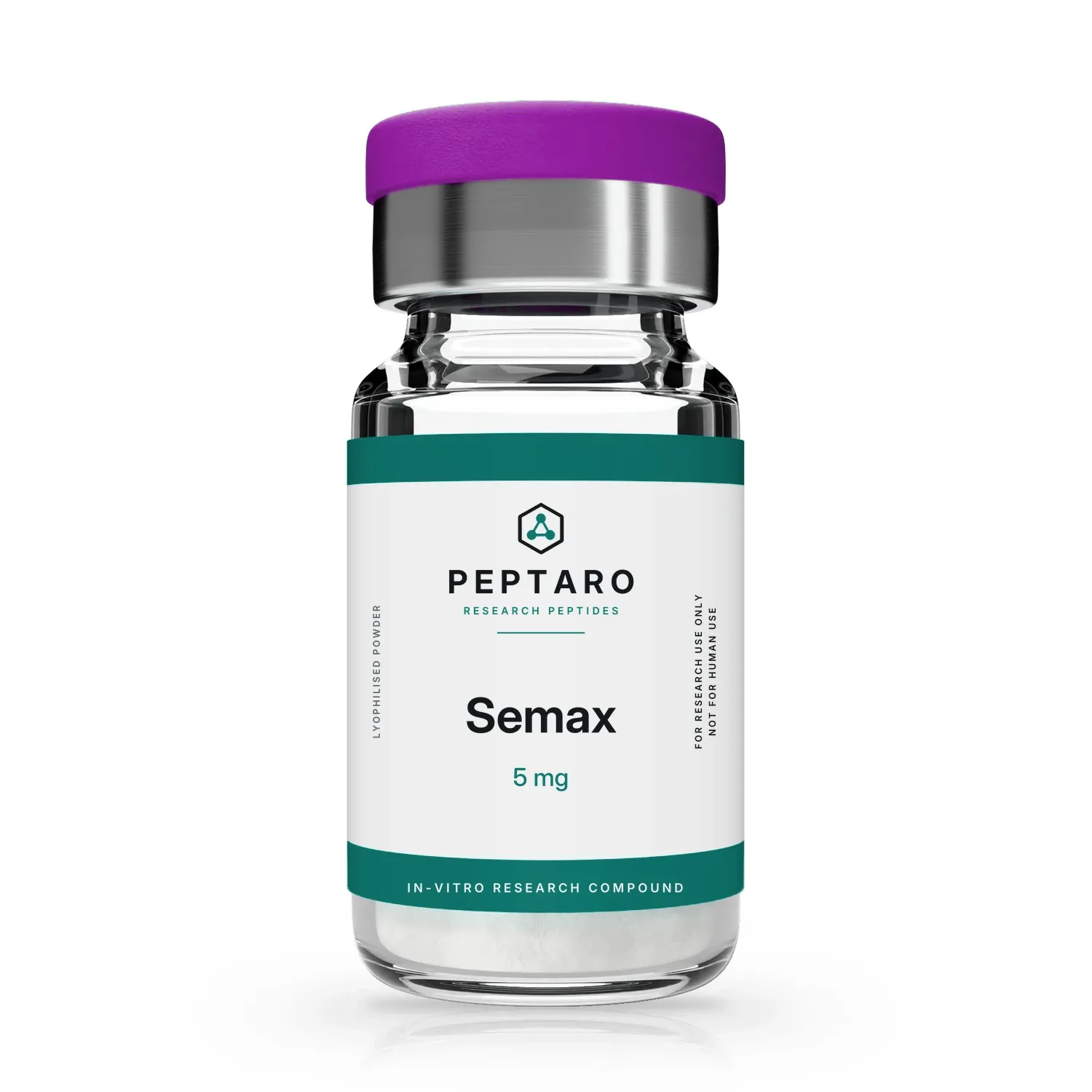
5mg
In Stock · Ready to Ship£39.99£8.00/mg
99.3% RP-HPLCJanoshikBatch UKPL-846
£18.99£3.80/mg
In Stock · Ready to Ship
Minimum order £299.00 per basket: mix any products. Research kits meet it on their own.
Dispatched same day if ordered by 3pm (Mon–Fri) · Royal Mail Tracked 24
| Vials in basket | Per vial | Saving |
|---|---|---|
| 1–2 | £18.99 | — |
| 3+ | £18.04 | 5% |
| 5+ | £17.47 | 8% |
| 10+ | £16.71 | 12% |
Discounts are basket-wide: mix any vials.
Documentation for each item ships with your order.
For in-vitro laboratory research use only. Not for human or veterinary use.
Documentation for each item ships with your order. The batch number printed on your vial matches it.
Semax is a synthetic analogue of ACTH fragment 4-10, a heptapeptide with the sequence Met-Glu-His-Phe-Pro-Gly-Pro. Research has examined its nootropic, neuroprotective and neurorestorative properties, including effects on BDNF expression and cognitive function. Semax can cross the blood-brain barrier, making it a key compound in neuroscience and cognitive research. This 5mg presentation is the entry research format, supplied in the same single lyophilised vial as the 10mg. Supplied as lyophilised powder, supplier-reported analysis, certificate published on this page.
Semax is a synthetic heptapeptide analogue of the ACTH(4-10) fragment, studied in rats for its effects on BDNF and other neurotrophins. Nearly all of its literature comes from Russian research groups. We sell Semax in 5mg and 10mg vials of white lyophilised powder.
Semax has the sequence Met-Glu-His-Phe-Pro-Gly-Pro (MEHFPGP). Its formula is C₃₇H₅₁N₉O₁₀S, its molecular weight 813.9 g/mol and its CAS number 80714-61-0. PubChem lists it as ACTH(4-7)-Pro-Gly-Pro.
The Met-Glu-His-Phe core comes from ACTH(4-10), and the Pro-Gly-Pro tail was added to slow enzymatic breakdown. Semax has none of the hormonal activity of ACTH. It was developed at the Institute of Molecular Genetics of the Russian Academy of Sciences.
Semax research is almost all preclinical and done in rats. Endpoints are neurotrophin gene and protein expression, trkB activation, infarct volume and conditioned avoidance tasks. Independent replication outside Russia is sparse.
Semax, Adamax and Selank share one design: a short active fragment protected by a C-terminal Pro-Gly-Pro. Semax carries the ACTH-derived Met-Glu-His-Phe core. Adamax comes from the same design line, but has little peer-reviewed characterisation outside the Russian literature, so Semax findings do not transfer to it. Selank puts the same tail on tuftsin, a Thr-Lys-Pro-Arg fragment of immunoglobulin G. Because the tail is shared, Semax and Selank are often studied side by side.
Semax is a synthetic heptapeptide derived from the adrenocorticotropic hormone (ACTH) fragment 4-10, with the sequence Met-Glu-His-Phe-Pro-Gly-Pro. Developed by the Institute of Molecular Genetics of the Russian Academy of Sciences, Semax has been approved as a pharmaceutical agent in Russia and Ukraine for neurological applications. Research focuses on its ability to modulate brain-derived neurotrophic factor (BDNF) and nerve growth factor (NGF) expression, conferring neuroprotective properties particularly relevant to ischaemic brain injury research. Studies have documented its effects on dopaminergic and serotonergic neurotransmitter systems, suggesting broad neuromodulatory activity beyond simple ACTH fragment effects. Semax has been clinically documented in stroke rehabilitation literature, where its neuroprotective and neurorestorative properties have been examined in post-ischaemic recovery models. The peptide crosses the blood-brain barrier efficiently, enabling central nervous system activity following peripheral administration. Researchers in neuroscience and cognitive pharmacology consider Semax a significant tool for studying neuroplasticity, neurotrophic factor regulation, and cognitive enhancement mechanisms in preclinical and clinical contexts.
Structurally Semax is ACTH(4-10) carrying a Pro-Gly-Pro extension at the C-terminus, and that tripeptide tail is the functionally important part of the design rather than an inert addition. PGP resists aminopeptidase cleavage, which is what gives the molecule a usable duration where the bare ACTH fragment has almost none. Critically, Semax retains the neurotropic activity of the parent fragment while being devoid of its corticotropic activity, so it does not drive adrenal steroidogenesis the way ACTH itself does. That separation of activities is the single most important pharmacological fact about the compound.
The neurotrophic mechanism is the most studied. Dolotov and colleagues reported increased BDNF and TrkB expression in rat hippocampus following administration, and the wider literature describes effects on NGF signalling alongside modulation of dopaminergic and serotonergic transmission. Semax is registered as a pharmaceutical in Russia, where it is used in stroke and cognitive indications.
The limitation should be stated rather than glossed over. Almost the entire evidence base is Russian-language and originates from a small number of affiliated institutions, and independent replication in Western laboratories is sparse. Very few placebo-controlled trials are indexed in the major English-language databases. Semax holds no marketing authorisation in the UK, the EU or the US, and is supplied here as a lyophilised research chemical for in-vitro laboratory use only.
Store sealed vials at -20°C, away from light and moisture, for up to 24 months. After reconstitution, keep the solution at 2-8°C and use it within 4 weeks. For longer storage, freeze single-use aliquots at -20°C. Repeated freeze-thaw cycles, light and dissolved oxygen all speed methionine oxidation.
Vials are sold on their own, without bacteriostatic water for mixing or other supplies.
How to reconstitute and handle
Let the vial reach room temperature and swab both stoppers with alcohol. Add the bacteriostatic water slowly down the inside wall of the vial, away from strong light, and keep the stopper open as briefly as possible. Swirl gently until the powder dissolves, without shaking. The solution should be clear and colourless.
For the full method, see the peptide reconstitution guide and the reconstitution calculator.
Published research on Semax is indexed on PubMed. See our full UK buyer's guide for Semax, UK buyer's guide for Semax 5mg and UK buyer's guide for Semax CoA.
| CAS number | 80714-61-0 |
|---|---|
| Molecular formula | C₃₇H₅₁N₉O₁₀S |
| Molecular weight | 813.9 g/mol |
| Sequence | Met-Glu-His-Phe-Pro-Gly-Pro (MEHFPGP) |
| Form | Lyophilised powder |
| Appearance | White lyophilised powder |
| Release specification | ≥98.0% |
| Storage | -20°C lyophilised, 2-8°C reconstituted |
Store sealed lyophilised vials at −20 °C, protected from light and moisture. For preparation, aliquoting and storage of reconstituted stock, see the laboratory reconstitution guide and the concentration calculator.
Semax has been studied in the context of cognitive enhancement, neuroprotection, stroke rehabilitation, and optic nerve disorders. Research has demonstrated that Semax upregulates brain-derived neurotrophic factor (BDNF) and nerve growth factor (NGF), which are involved in neuronal survival, synaptic plasticity, and cognitive function.
Only as a hypothesis. Tsai (Medical Hypotheses, 2007) proposed Semax as a candidate for attention-deficit research after Dolotov and colleagues (Brain Research, 2006) reported raised BDNF and TrkB expression in the rat hippocampus. No controlled trial of Semax in ADHD has been published, so there is no clinical evidence either way. See our [Semax vs Selank comparison](/blog/semax-vs-selank-nootropic-comparison) for the full reference list.
Semax was developed by the Institute of Molecular Genetics of the Russian Academy of Sciences and has been approved as a pharmaceutical product in Russia and Ukraine for neurological applications. It is supplied as a research compound in the UK.
Each vial contains Semax lyophilised powder (freeze-dried for stability). Semax has a molecular weight of 813.9 g/mol with the molecular formula C₃₇H₅₁N₉O₁₀S. This compound is supplied for research use only.
You can buy Semax peptide online from our UK stock in 5mg and 10mg vials, each with a published certificate. The 10mg batch carries a Janoshik Analytical report you can look up on their site; the 5mg batch is a supplier-reported analysis with independent verification pending. Orders placed before 3pm on a working day are dispatched the same day, and tracked UK delivery is free on every order.
Not yet. The certificate for batch UKPL-846 is a supplier-reported analysis: 99.3% purity by RP-HPLC, 4.87mg of material present against the 5mg label. Independent third-party verification is pending, and the full certificate is published on this product page.
Semax peptide lets researchers study an ACTH(4-10)-derived sequence without ACTH's hormonal activity. Most papers measure neurotrophin gene and protein expression in rat brain.
No. Peptaro supplies Semax 5mg strictly for in-vitro laboratory research. It is not a medicine and is not for human or veterinary use, and we don't give usage advice.
-20°C lyophilised, 2-8°C reconstituted. For preparing and aliquoting stock solutions, see the laboratory reconstitution guide.
Orders placed by 3pm Monday to Friday (excluding bank holidays) are dispatched the same working day by Royal Mail Tracked 24. Delivery is free, tracked and cold-packed. The minimum order is £299.
Research use only. For in-vitro laboratory research use only. Not for human or veterinary use. By continuing you confirm you are 18+ and purchasing for laboratory research.